How to Fix â€å“the Uploaded File Could Not Be Moved to Wp-contentã¢â‚¬â Error Message

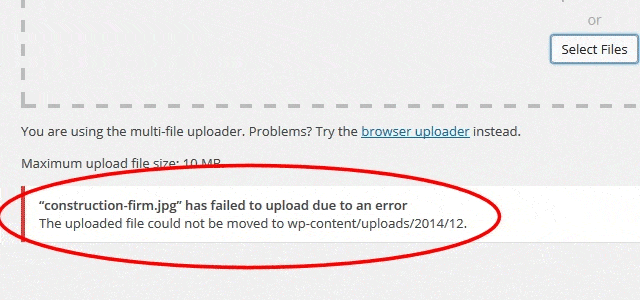
At some point in your WordPress admin career and ESPECIALLY if you are in the business of migrating websites from one server to some other you will Eventually see this error bulletin when attempting to add images to your media library:
"<image-name> has failed to upload due to an error. The uploaded file could not be moved to wp-content/residuum-of-path-hither"
An boosted side effect of this same error is that fact that you are NOT able to automatically update existing plugins OR add new ones. When yous try to add a new plugin (for example), WordPress will gracefully nowadays you with an FTP credentials screen then that yous tin manually upload the new plugin. And then…..
WHY IS THIS HAPPENING?
In Nigh instances, (especially in the case of a MIGRATED website which was already running without issues on some other webserver) what is happening is that WordPress passes off the FETCHING (or uploading) of the requested image to the web server process on which your website resides and information technology happily retrieves the image.jpg from your harddrive and uploads to temporary retentivity of the server THEN tries to commit the file into storage of the WordPress media library (which is about often /wp-content/uploads/<yr>/<mo>). This of course is where the error occurs. The business relationship that actually RETRIEVES the file from your estimator is the Apache service business relationship and many times the NOBODY account (yes, that IS the existent proper noun of the account) on the server itself. Since that particular account has NO Ownership or rights to the /wp-content/uploads/<year>/<mo> folder… you become the dainty fault message indicating there was an issue placing the image in that detail folder. THIS IS Past Pattern PEOPLE … and it means your web server is simply enforcing the security parameters it is aware of…. Which is a proficient matter!
SOME REALLY BAD ADVICE
So like any other adept WordPress admin and to try and resolve this issue, you copy – paste – and Google. What y'all will detect even so should not only Shock you lot but should make the hair on your security-conscience neck stand upwardly! ix out of ten "recommendations" on how to resolve this problem involve setting the permissions on your /wp-content/uploads folder to 777!!! … to that I say NO – NO – NO! If you're going to do that you might equally well change the password to your "admin" account to 12345 besides!
And then LETS INSTEAD Really FIX THE Effect… THE PROPER WAY
Footstep 1: Detect out which business relationship on your server is the Apache Service Business relationship – Unfortunately, this part is not e'er easy for those with a shared hosting account and NO shell (sometimes called SSH) admission to their site. UPDATE: See the link provided below by jervisbay in the comments section on how to ready this issue in a shared hosting environment. Thx jervisbay! The intimidation cistron is that shell access is a basic control line interface… you know, the quondam black screen with white text and a command prompt… YUCK! However, if y'all DON'T have this type of access… but electronic mail your hosting support team with this elementary question…What is the name of my website's Apache Service Account? Y'all might also want to say in your email that you are trying to set the proper permissions on your WordPress installation and that should help give them some context every bit to your request.
Now… if you Exercise take shell access to your website go ahead and login using a crush plan like Putty (our favorite). If you are on a VPS or Reseller server, yous volition likely have access using the <root> user which IS preferred. For shared servers, you lot will probable NOT have beat admission and volition instead accept to send a support email.
Note: The instructions below are only for Reseller, VPS, and Dedicated server environments. The reason being is that we are granting access to a SERVICE running globally on these machine types. This is Not something y'all'd want to do in a SHARED hosting surround considering obviously it would open you up to a whole new fix of security concerns.
However to get around this, shared hosting environments implement a technique chosen "suexec" which abstracts the account access yet gives proper rights to enable functionality to work every bit it should. SUEXEC is a topic for another blog post discussion, but yous might desire to mention it in your back up email (should you go that route). As a affair of fact, here'south a pretty hearty discussion on the topic which you might enjoy.
Once logged in as root, execute this command:
ps aux | egrep '(apache|httpd)'
This should return output (and a list) like the following:
root 5597 0.0 0.1 70904 6552 ? Ss Nov18 2:03 /usr/local/apache/bin/httpd -k start -DSSL
nobody 8715 0.0 0.0 69728 2516 ? South 17:11 0:00 /usr/local/apache/bin/httpd -k start -DSSL
nobody 8717 0.0 0.0 70904 2608 ? South 17:eleven 0:00 /usr/local/apache/bin/httpd -one thousand outset -DSSL
nobody 8718 0.1 0.4 1332864 17180 ? Sl 17:eleven 0:06 /usr/local/apache/bin/httpd -k start -DSSL
nobody 8719 0.1 0.iv 1333004 17012 ? Sl 17:xi 0:07 /usr/local/apache/bin/httpd -k start -DSSL
nobody 8720 0.1 0.4 1333356 16828 ? Sl 17:11 0:07 /usr/local/apache/bin/httpd -k commencement -DSSL
nobody 8808 0.1 0.four 1333584 16088 ? Sl 17:12 0:06 /usr/local/apache/bin/httpd -k outset -DSSL
nobody 11467 0.one 0.two 1332816 11696 ? Sl 18:51 0:00 /usr/local/apache/bin/httpd -k kickoff -DSSL
root 11611 0.0 0.0 4052 188 pts/0 D+ eighteen:56 0:00 egrep (apache|httpd)
The account name of nobody (highlighted in blackness to a higher place) indicates that THIS is my apache service account and the i I should grant access to my entire WordPress files in order for life to be adept one time over again.
Pace 2: Grant this user rights to the WordPress install – This procedure is quite simple… just execute the post-obit command within your vanquish windows:
chown -R nobody /home/<username>/public_html
This of class assumes that the root of your WordPress installation is inside the public_html binder (quite standard on nigh all CPanel / Linux installations). What this command does is it starts at the root path of WordPress and grants the user called nobody with ownership rights on ALL files and folders RECURSIVELY (meaning information technology includes sub-folders and files within sub-folders likewise) throughout the site.
Problem SOLVED!
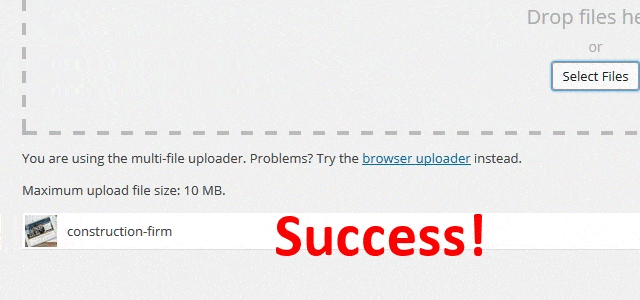
And so that should exercise it! At present go dorsum to your WordPress admin control panel and attempt your paradigm upload to the media library again. You should find that all works without effect (every bit in the prototype below). Also, you will now be able to automatically update and upgrade plugins within the site.
Source: https://2surge.com/how-to-fix-the-uploaded-file-could-not-be-moved-to-wp-content-error-message.html
0 Response to "How to Fix â€å“the Uploaded File Could Not Be Moved to Wp-contentã¢â‚¬â Error Message"
Post a Comment