Once Youve Had the Norovirus Can You Get It Again
In the last few months, schools all over the land have airtight because of outbreaks of norovirus. Also known as tum flu, norovirus infections cause watery diarrhea, low-grade fever and, virtually alarming of all, projectile vomiting, which is an extremely effective way of spreading the virus.
Norovirus is very infectious and spreads rapidly through a confined population, such every bit at a schoolhouse or on a cruise ship. Although almost sufferers recover in 24 to 48 hours, norovirus is a leading cause of childhood illness and, in developing countries, results in most fifty,000 kid deaths each twelvemonth.
Interestingly, non everyone is equally vulnerable to the virus, and whether you get sick or not may depend on your blood type.
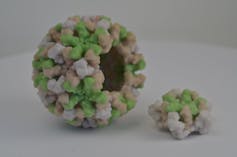
Norovirus is difficult to go rid of
I am a microbiologist, and I got interested in norovirus considering, while norovirus symptoms are deplorable under any circumstances, my encounter with the virus was particularly inconvenient. During a 7-day rafting trip downwardly the Grand Canyon, the illness passed through the rafters and crew, one by one. Obviously, the wilderness sanitary facilities were non the best to cope with this outbreak. Luckily, anybody, including me, recovered chop-chop. It turns out that norovirus outbreaks on Colorado River rafting trips are common.
Equally debilitating as the illness it causes can be, the norovirus particle is visually beautiful. Information technology is a type of virus known as "non-enveloped" or "naked," which means that information technology never acquires the membrane coating typical of other viruses, such as the flu virus. The norovirus surface is a protein coat, called the "capsid." The capsid protects the norovirus' genetic material.
The naked capsid coat is 1 factor that makes norovirus so difficult to control. Viruses with membrane coatings are susceptible to booze and detergents, but not so norovirus. Norovirus tin can survive temperatures from freezing to 145 degrees Fahrenheit (about the maximum water temperature in a home dishwasher), soap and mild solutions of bleach. Norovirus can persist on human being easily for hours and on solid surfaces and food for days and is likewise resistant to booze-based hand sanitizers.
To make things worse, only a tiny dose of the virus – equally few every bit 10 viral particles – is needed to cause disease. Given that an infected person tin can excrete many billions of viral particles, it's very hard to forestall the virus from spreading.
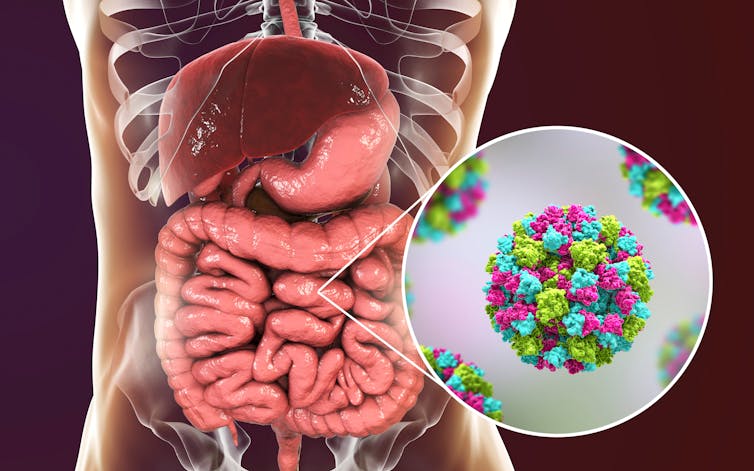
Susceptibility to norovirus depends on blood type
When norovirus is ingested, it initially infects the cells that line the small intestine. Researchers don't know exactly how this infection and then causes the symptoms of the affliction. But a fascinating aspect of norovirus is that, after exposure, blood type determines, in a large part, whether a person gets sick.
Your claret type – A, B, AB or O – is dictated past genes that decide which kinds of molecules, called oligosaccharides, are plant on the surface of your ruby-red blood cells. Oligosaccharides are made from dissimilar types of sugars linked together in complex ways.
The same oligosaccharides on red blood cells likewise appear on the surface of cells that line the small intestine. Norovirus and a few other viruses employ these oligosaccharides to grab onto and infect the intestinal cells. It'southward the specific structure of these oligosaccharides that determines whether a given strain of virus can adhere and invade.
The presence of one oligosaccharide, called the H1-antigen, is required for attachment by many norovirus strains.
People who practice not make H1-antigen in their intestinal cells make upward 20% of the European-derived population and are resistant to many strains of norovirus.
More sugars tin can be attached to the H1-antigen to give the A, B or AB blood types. People who tin can't make the A and B modifications have the O blood type.

Different strains of norovirus infect unlike people
Norovirus evolves rapidly. In that location are 29 different strains currently known to infect humans, and each strain has different variants. Each i has unlike abilities to bind to the variously shaped saccharide molecules on the abdominal cell surface. These sugars are determined past claret type.
If a grouping of people is exposed to a strain of norovirus, who gets sick volition depend on each person's blood blazon. But, if the same grouping of people is exposed to a dissimilar strain of norovirus, different people may be resistant or susceptible. In full general, those who practise non brand the H1-antigen and people with B claret type will tend to exist resistant, whereas people with A, AB, or O claret types will tend to become sick, but the pattern volition depend on the specific strain of norovirus.
This difference in susceptibility has an interesting issue. When an outbreak occurs, for example, on a prowl send, roughly a third of the people may escape infection. Considering they exercise non know the underlying reason for their resistance, I think spared people engage in magical thinking – for example, "I didn't get ill because I drank a lot of grape juice." Of course, these mythical evasive techniques will not work if the side by side outbreak is a strain to which the individual is susceptible.
Immunity to norovirus is curt-lived
A norovirus infection provokes a robust immune response that eliminates the virus in a few days. Even so, the response appears to be short-lived. Almost studies have constitute that immunity guarding against reinfection with the aforementioned norovirus strain lasts less than six months. As well, infection with ane strain of norovirus offers trivial protection confronting infection from another. Thus, you can have repeated bouts with norovirus.
The diverseness of norovirus strains and the impermanence of the immune response complicates evolution of an effective vaccine. Currently, clinical trials are testing the effects of vaccines made from the capsid proteins of the 2 almost prevalent norovirus strains.
In general, these experimental vaccines produce good immune responses; the longevity of the immune response is at present nether written report. The adjacent stage of clinical trials volition examination if the vaccines actually foreclose or reduce the symptoms of norovirus infection.
[ Similar what you've read? Want more? Sign upwardly for The Conversation'south daily newsletter. ]
Source: https://theconversation.com/your-blood-type-may-influence-your-vulnerability-to-norovirus-the-winter-vomiting-virus-129125
0 Response to "Once Youve Had the Norovirus Can You Get It Again"
Post a Comment