Can Liquid Water Form Lasting Structures Consisting of 6, 12, 13, 16 or More Molecules?
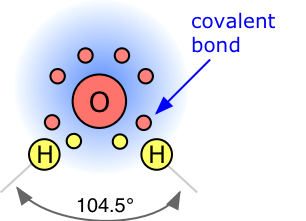
The molecule of water
A molecule is an assemblage of diminutive nuclei and electrons that is sufficiently stable to possess observable properties — and there are few molecules that are more stable and hard to decompose than HtwoO. In water, each hydrogen nucleus is spring to the central oxygen atom past a pair of electrons that are shared betwixt them; chemists call this shared electron pair a covalent chemic bail. In HtwoO, just two of the six outer-beat out electrons of oxygen are used for this purpose, leaving 4 electrons which are organized into two not-bonding pairs. The four electron pairs surrounding the oxygen tend to arrange themselves as far from each other every bit possible in lodge to minimize repulsions betwixt these clouds of negative charge. This would ordinarly result in a tetrahedral geometry in which the bending betwixt electron pairs (and therefore the H-O-H bond angle) is 109.5°. However, because the two non-bonding pairs remain closer to the oxygen atom, these exert a stronger repulsion against the 2 covalent bonding pairs, effectively pushing the two hydrogen atoms closer together. The result is a distorted tetrahedral arrangement in which the H—O—H angle is 104.five°.
Although the water molecule carries no cyberspace electric charge, its eight electrons are non distributed uniformly; in that location is slightly more negative charge (purple) at the oxygen end of the molecule, and a compensating positive charge (green) at the hydrogen stop. The resulting polarity is largely responsible for water's unique properties.
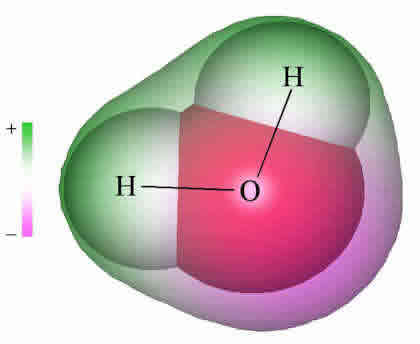 Because molecules are smaller than light waves, they cannot exist observed directly, and must be "visualized" past alternative means. This estimator-generated epitome comes from calculations that model the electron distribution in the H2O molecule. The outer envelope shows the effective "surface" of the molecule every bit defined by the extent of the cloud of negative electric charge created by the viii electrons.
See the SBU Water Site for more information on this model.
Hydrogen bonding
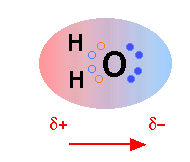 The H2O molecule is electrically neutral, but the positive and negative charges are not distributed uniformly. This is illustrated by the gradation in color in the schematic diagram here. The electronic (negative) charge is concentrated at the oxygen stop of the molecule, owing partly to the nonbonding electrons (solid blue circles), and to oxygen'southward high nuclear charge which exerts stronger attractions on the electrons. This charge displacement constitutes an electrical dipole, represented by the arrow at the bottom; you can think of this dipole as the electrical "epitome" of a water molecule.
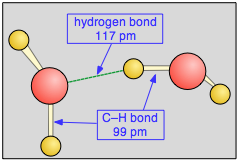 As nosotros all learned in school, opposite charges concenter, and so the partially-positive hydrogen atom on 1 h2o molecule is electrostatically attracted to the partially-negative oxygen on a neighboring molecule. This process is called (somewhat misleadingly) hydrogen bonding. Notice that the hydrogen bond (shown by the dashed light-green line) is somewhat longer than the covalent O—H bail. This means that it is considerably weaker; information technology is so weak, in fact,that a given hydrogen bond cannot survive for more than a tiny fraction of a 2d.
The anomalous backdrop of water
Water has long been known to showroom many physical backdrop that distinguish it from other small molecules of comparable mass. Chemists refer to these as the "anomalous" properties of water, only they are past no means mysterious; all are entirely anticipated consequences of the manner the size and nuclear accuse of the oxygen cantlet conspire to misconstrue the electronic accuse clouds of the atoms of other elements when these are chemically bonded to the oxygen.
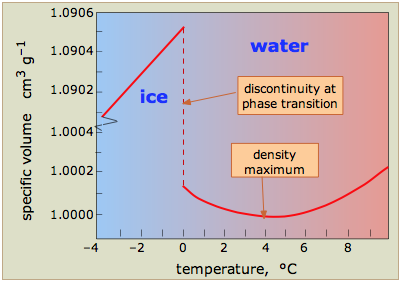 H2o is one of the few known substances whose solid class is less dense than the liquid. The plot at the right shows how the volume of water varies with the temperature; the large increase (about nine%) on freezing shows why water ice floats on water and why pipes burst when they freeze. The expansion between –4° and 0° is due to the formation of larger hydrogen-bonded aggregates. Above 4°, thermal expansion sets in equally vibrations of the O—H bonds becomes more vigorous, disposed to shove the molecules farther autonomously.
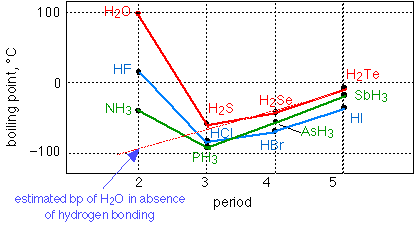 The other widely-cited dissonant belongings of water is its high boiling point. Every bit this graph shows, a molecule as light equally HtwoO "should" boil at around –90°C; that is, information technology would be in the world as a gas rather than a liquid if H-bonding were not present. Notice that H-bonding is too observed with fluorine and nitrogen.
Surface tension and wetting
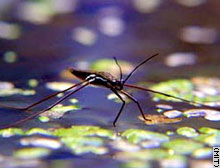 Accept you e'er watched an insect walk across the surface of a swimming? The water strider takes advantage of the fact that the h2o surface acts similar an elastic film that resists deformation when a small weight is placed on it. (If you are conscientious, you tin also "bladder" a small paper clip or steel staple on the surface of h2o in a cup.) This is all due to the surface tension of the water. A molecule inside the bulk of a liquid experiences attractions to neighboring molecules in all directions, but since these average out to zero, there is no net force on the molecule. For a molecule that finds itself at the surface, the state of affairs is quite different; it experiences forces only sideways and downward, and this is what creates the stretched-membrane effect.
The distinction between molecules located at the surface and those deep inside is specially prominent in H2O, owing to the strong hydrogen-bonding forces. The deviation between the forces experienced by a molecule at the surface and one in the bulk liquid gives rising to the liquid'southward surface tension.
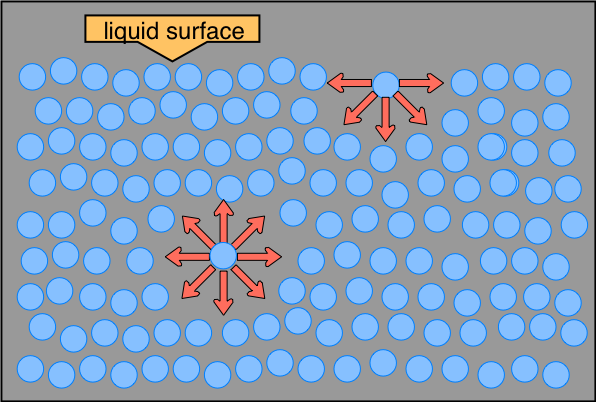 This cartoon highlights two HiiO molecules, one at the surface, and the other in the majority of the liquid. The surface molecule is attracted to its neighbors below and to either side, just in that location are no attractions pointing in the 180° solid angle angle above the surface. Equally a event, a molecule at the surface volition tend to be fatigued into the bulk of the liquid. Only since at that place must always be some surface, the overall effect is to minimize the area of a liquid.
 The geometric shape that has the smallest ratio of surface expanse to volume is the sphere, so very modest quantities of liquids tend to form spherical drops. Every bit the drops get bigger, their weight deforms them into the typical tear shape.
[image: Crawford Wilson III]
Wetting
Take a plastic mixing bowl from your kitchen, and splash some water around in it. You will probably detect that the water does not comprehend the inside surface uniformly, simply remains dispersed into drops. The same effect is seen on a dirty windshield; turning on the wipers simply breaks hundreds of drops into thousands. By contrast, water poured over a clean glass surface will wet information technology, leaving a uniform picture.
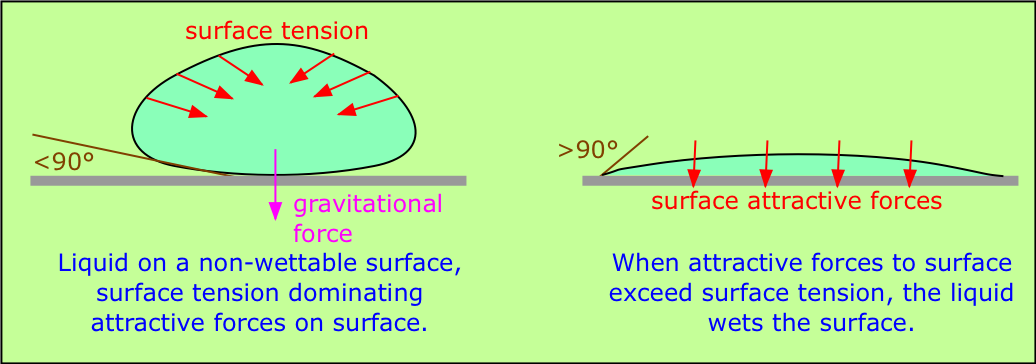
When a liquid is in contact with a solid surface, its behavior depends on the relative magnitudes of the surface tension forces and the bonny forces between the molecules of the liquid and of those comprising the surface. If an H2O molecule is more strongly attracted to its own kind, then surface tension will boss, increasing the curvature of the interface. This is what happens at the interface between water and a hydrophobic surface such as a plastic mixing bowl or a windshield coated with oily cloth. A make clean glass surface, by contrast, has -OH groups sticking out of information technology which readily attach to water molecules through hydrogen bonding; this causes the water to spread out evenly over the surface, or to wet it. A liquid will wet a surface if the angle at which it makes contact with the surface is more than 90°. The value of this contact angle can be predicted from the properties of the liquid and solid separately.
If we desire water to wet a surface that is not usually wettable, we add together a detergent to the water to reduce its surface tension. A detergent is a special kind of molecule in which one end is attracted to H2O molecules but the other end is non, so these ends stick out above the surface and repel each other, cancelling out the surface tension forces due to the h2o molecules alone.
Water the liquid
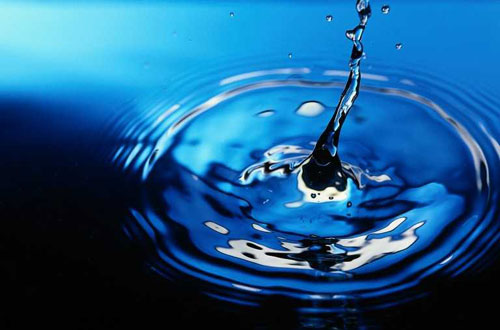 The nature of liquid water and how the
HiiO molecules within information technology are organized and interact are questions that have attracted the interest of chemists for many years. At that place is probably no liquid that has received more intensive written report, and there is at present a huge literature on this field of study.
The following facts are well established:
- H2O molecules attract each other through the special type of dipole-dipole interaction known every bit hydrogen bonding
- a hydrogen-bonded cluster in which iv H2Os are located at the corners of an imaginary tetrahedron is an specially favorable (low-potential energy) configuration, but...
- the molecules undergo rapid thermal motions on a time scale of picoseconds (10–12 second), and so the lifetime of any specific clustered configuration will exist fleetingly brief.
A variety of techniques including infrared assimilation, neutron scattering, and nuclear magnetic resonance accept been used to probe the microscopic structure of water. The information garnered from these experiments and from theoretical calculations has led to the development of around 20 "models" that attempt to explain the construction and beliefs of water. More than recently, computer simulations of various kinds have been employed to explore how well these models are able to predict the observed physical properties of h2o.
This work has led to a gradual refinement of our views nigh the construction of liquid water, but it has non produced any definitive answer. There are several reasons for this, but the principal one is that the very concept of "structure" (and of water "clusters") depends on both the fourth dimension frame and volume under consideration. Thus questions of the following kinds are still open:
- How do you distinguish the members of a "cluster" from next molecules that are not in that cluster?
- Since individual hydrogen bonds are continually breaking and re-forming on a picosecond fourth dimension scale, practise water clusters have any meaningful existence over longer periods of time? In other words, clusters are transient, whereas "construction" implies a molecular arrangement that is more than enduring. Can nosotros and then legitimately use the term "clusters" in describing the structure of h2o?
- The possible locations of neighboring molecules around a given H2O are limited by energetic and geometric considerations, thus giving ascension to a certain amount of "construction" within any pocket-size book element. Information technology is not clear, however, to what extent these structures interact as the size of the volume element is enlarged. And as mentioned above, to what extent are these structures maintained for periods longer than a few picoseconds?
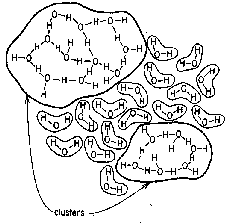 The view first adult in the 1950's that water is a collection of "flickering clusters" of varying sizes (correct) has gradually been abandoned as being unable to account for many of the observed properties of the liquid.
Current views of water construction
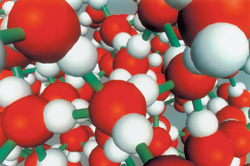
The nowadays thinking, influenced greatly past molecular modeling simulations commencement in the 1980s, is that on a very curt time calibration (less than a picosecond), water is more like a "gel" consisting of a single, huge hydrogen-bonded cluster. On a 10-12-10-ix sec time scale, rotations and other thermal motions cause individual hydrogen bonds to break and re-form in new configurations, inducing ever-changing local discontinuities whose extent and influence depends on the temperature and pressure.
| Contempo work from Richard SayKally'southward laboratory shows that the hydrogen bonds in liquid water break and re-form then speedily (often in distorted configurations) that the liquid tin be regarded every bit a continuous network of hydrogen-bonded molecules. | This estimator-generated nanoscale view of liquid water is from the lab of Factor Stanley of Boston University [source]. The oxygen atoms are carmine, the hydrogen atoms white |
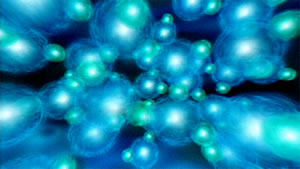
Local structures and water clusters
Information technology is quite likely that over very modest volumes, localized (H2O) n polymeric clusters may have a fleeting existence, and many theoretical calculations have been made showing that some combinations are more stable than others. While this might prolong their lifetimes, information technology does not appear that they remain intact long enough to detect as straight observable entities in ordinary majority h2o at normal pressures.
Theoretical models suggest that the average cluster may encompass equally many as 90 H2O molecules at 0°C, and then that very cold h2o tin be idea of equally a collection of ever-changing ice-like structures. At 70° C, the boilerplate cluster size is probably no greater than most 25.
It must be emphasized that no stable clustered unit or arrangement has ever been isolated or identified in pure bulk liquid h2o. A 2006 report suggests that a simple tetrahedral arrangement is the merely long-range structure that persists at time scales of a picosecond or beyond. Just for an interesting (and somewhat controversial) alternative view, see this PDF article by the tardily Rustum Roy.
Water clusters are of considerable interest as models for the study of water and h2o surfaces, and many articles on them are published every twelvemonth. Some notable work reported in 2004 extended our view of h2o to the femtosecond fourth dimension scale. The principal finding was that 80 per centum of the water molecules are leap in concatenation-similar way to only 2 other molecules at room temperature, thus supporting the prevailing view of a dynamically-changing, matted h2o structure.
Some recent work involving novel experimental and computational techniques has revealed more well-nigh water structure:
- Lawrence Livermore National Laboratory: Revealing the Mysteries of H2o
- Water: Dissolving the Controversy — this page is from the UC-Berkely lab of Richard Saykally, one of the world's experts on water structure.
Liquid and solid water
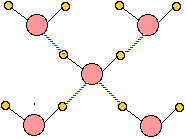 Ice, like all solids, has a well-defined structure; each water molecule is surrounded by 4 neighboring H2Bone. two of these are hydrogen-bonded to the oxygen atom on the primal HiiO molecule, and each of the ii hydrogen atoms is similarly bonded to another neighboring H2O.
The hydrogen bonds are represented by the dashed lines in this ii-dimensional schematic diagram. In reality, the iv bonds from each O atom betoken toward the four corners of a tetrahedron centered on the O cantlet. This bones assembly repeats itself in three dimensions to build the water ice crystal.
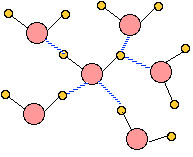 When water ice melts to form liquid water, the uniform three-dimensional tetrahedral organization of the solid breaks down as thermal motions disrupt, distort, and occasionally intermission hydrogen bonds. The methods used to determine the positions of molecules in a solid do not work with liquids, and then there is no unambiguous way of determining the detailed structure of water. The illustration here is probably typical of the organization of neighbors effectually any particular H2O molecule, merely very picayune is known nearly the extent to which an arrangement like this gets propagated to more distant molecules.
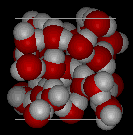
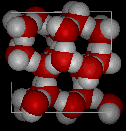 Here are three-dimensional views of a typical local structure of water (left) and ice (right.) Notice the greater openness of the ice structure which is necessary to ensure the strongest degree of hydrogen bonding in a uniform, extended crystal lattice. The more crowded and jumbled arrangement in liquid water tin be sustained only by the greater amount thermal free energy available above the freezing indicate. [image source]
For more on the structure of water ice:
- A very readable article on water ice structure.
- This Water ice Construction page from U. of Wisconsin has some first-class graphics illustrating the structures of ordinary ice equally well as of its high-pressure polymorphs.
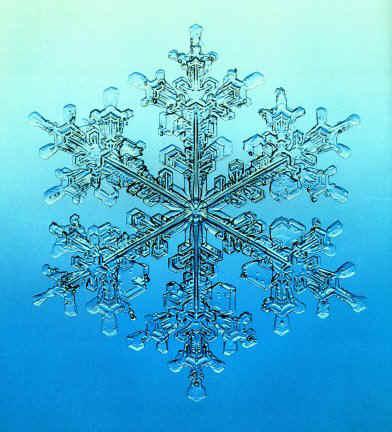 | The stable arrangement of hydrogen-bonded water molecules in ice gives ascent to the beautiful hexagonal symmetry that reveals itself in every snowflake. For almost everything there is to know about snowflakes (and a lot of nice images), see this SnowCrystals page from CalTech. |
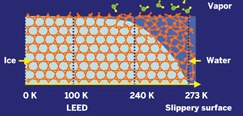 Why is ice slippery?
At temperatures as low as 200K, the surface of ice is highly disordered and water-like. As the temperature approaches the freezing point, this region of disorder extends farther downwardly from the surface and acts as a lubricant.
The analogy is taken from from an article in the Apr 7, 2008 issue of C&EN honoring the physical chemist Gabor Somorjai who pioneered mod methods of studying surfaces.
"Pure" h2o
To a chemist, the term "pure" has meaning only in the context of a particular application or process. The distilled or de-ionized water nosotros utilise in the laboratory contains dissolved atmospheric gases and occasionally some silica, but their small amounts and relative inertness make these impurities insignificant for most purposes. When water of the highest obtainable purity is required for certain types of exacting measurements, it is ordinarily filtered, de-ionized, and triple-vacuum distilled. But even this "chemically pure" water is a mixture of isotopic species: there are two stable isotopes of both hydrogen (H1 and Htwo, the latter often denoted by D) and oxygen (O16 and O18) which give rise to combinations such as H2Oxviii, HDO16, etc., all of which are readily identifiable in the infrared spectra of water vapor. And to top this off, the two hydrogen atoms in water comprise protons whose magnetic moments can be parallel or antiparallel, giving rise to ortho- and para-water, respectively. The two forms are normally present in a o/p ratio of 3:1.
The amount of the rare isotopes of oxygen and hydrogen in water varies enough from place to place that it is at present possible to decide the age and source of a detail water sample with some precision. These differences are reflected in the H and O isotopic profiles of organisms. Thus the isotopic analysis of human hair can be a useful tool for offense investigations and anthropology research. Run across besides this Microbe Forensics folio, and this general resource on water isotopes.
Information technology has recently been found (Langmuir 2003, 19, 6851-6856) that freshly distilled h2o takes a surprisingly long fourth dimension to equilibrate with the atmosphere, that information technology undergoes big fluctuations in pH and redox potential, and that these furnishings are greater when the water is exposed to a magnetic field. The reasons for this behavior are not clear, but i possibility is that dissolved O2 molecles, which are paramagnetic, might be involved.
Drinking water
Our ordinary drinking water, by contrast, is never chemically pure, especially if it has been in contact with sediments. Groundwaters (from springs or wells) ever comprise ions of calcium and magnesium, and often iron and manganese every bit well; the positive charges of these ions are counterbalanced by the negative ions carbonate/bicarbonate, and occasionally some chloride and sulfate. Groundwaters in some regions contain unacceptably loftier concentrations of naturally-occuring toxic elements such as selenium and arsenic.
1 might call back that pelting or snowfall would be exempt from contagion, but when h2o vapor condenses out of the atmosphere information technology always does so on a particle of dust which releases substances into the water, and even the purest air contains carbon dioxide which dissolves to form carbonic acid. Except in highly polluted atmospheres, the impurities picked up by snow and rain are too minute to exist of concern.
Various governments have established upper limits on the amounts of contaminants allowable in drinking water; the best known of these are the U.Southward. EPA Drinking Water Standards.
What kind of water is most healthy to potable?
I am not aware of any evidence indicating that whatsoever i type of h2o (including highly "pure" water) is more beneficial to wellness than any other, every bit long equally the h2o is pathogen-gratis and meets accepted standards such as those mentioned above. For those who are sensitive to residual chlorine or nevertheless take concerns, a good activated-carbon filter is commonly satisfactory. More farthermost measures such as reverse-osmosis or distillation are only justified in demonstrably farthermost situations.
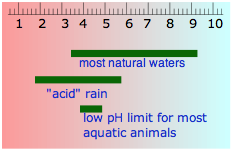 "Pure" rainwater always contains some dissolved carbon dioxide which makes it slightly acidic. When this water comes into contact with sediments, it tends to dissolve them, and in the process becomes alkaline. The pH of drinking h2o can vary from effectually v to ix, and it has no effect on ane's wellness. The idea that alkaline metal water is better to drink than acidic water is widely promoted by alternative-health hucksters who market worthless "water ionizer" machines for this purpose. Acidic water is sometimes described past engineers as "aggressive"; this refers to its tendency to corrode metal distribution pipes, but in this sense it is no more than active than the hydrochloric acid already present in your gastric fluid!
Ion-gratis water
1 occasionally hears that mineral-free water, and peculiarly distilled water, are unhealthy because they "leach out" required minerals from the trunk. In that location is no truth to this; the fact is that mineral ions do not pass through cell walls past ordinary osmotic diffusion, but rather are actively transported by metabolic processes. An extensive 2008 study failed to ostend earlier reports that low calcium/magnesium in drinking water correlates with cardiovascular disease. Any well-balanced diet should supply all the mineral substances nosotros need.
Information technology is well known that people who are engaged in heavy physical activity or are in a very hot environment should avoid drinking large quantities of even ordinary water. In order to prevent serious electrolyte imbalance issues, it is necessary to brand up for the salts lost through perspiration. This can be accomplished past ingestion of salted foods or beverages (including "sports beverages"), or table salt tablets.
Water in our bodies
Almost two-thirds of the weight of an adult man consists of h2o. About two-thirds of this water is located within cells, while the remaining third consists of extracellular water, mostly in the claret plasma and in the interstitial fluid that bathes the cells. This water, amounting to about v percent of body weight (about 5 50 in the adult), serves as a supporting fluid for the blood cells and acts every bit a ways of transporting chemicals between cells and the external surroundings. Information technology is basically a 0.15M solution of table salt (NaCl) containing smaller amounts of other electrolytes, the nearly important of which are bicarbonate (HCO3 –) and poly peptide anions.
For more information, see this Fluid Physiology on-line text.
The water content of our bodies is tightly controlled in respect to both total volume and its content of dissolved substances, particulary ions. Drinking constitutes only one source of our water; many foods, peculiarly those containing cells (fruits, vegetables, meats) are an important secondary source. In improver, a considerable amount of h2o (350-400 mL/day) is produced metabolically — that is, from the oxidation of glucose derived from foods.
The quantity of h2o exchanged within various parts of our bodies is surprisingly large. The kidneys process about 180 L/day, returning most of the water to the blood stream. Lymph flow amounts to one-two.5 L/day, and turnover of fluids in the bowel to eight-9 L/solar day. These figures are dwarfed by the 80,000 50/day of water that diffuses in both directions through capillary walls.
How much water should I drinkable?
The thought that anybody should potable "eight glasses" of h2o a day is one of those urban legends that never seems to get abroad; it is nicely debunked at this medical myths site. This Mayo Clinic page offers sensible guidelines.
The body's daily water loss
Loss through breath: 800 mL
Minimal sweat loss: 100 mL
Fecal loss: 200 mL
Minimal urine loss: 500 mL
Full: 1600 mL
Ultimately, total water intake plus metabolic production must residual h2o loss. For a salubrious unstressed adult, the figures shown here are typical minimum values. Discover that the major loss is through simple animate. The minimal urinary loss is adamant by the need to remove salts and other solutes taken in with foods or produced past metabolic processes. Individuals (such every bit many elderly) having reduced kidney function produce more dilute urine, and must therefore take in more than water. And of course stress factors such as strenuous practise, exposure to very loftier temperatures, or diarrhea can greatly increase the need for water intake.
Consumption of overly large quantities of h2o can lead to electrolyte imbalance resulting in water intoxication. Children, with their low body masses, are especially susceptible. A 2008 report recommends that young infants should never be given h2o.
Bound water
As nosotros explained above, bulk liquid water consists of a seething mass of various-sized chain-like groups and that flicker in and out of being on a fourth dimension scale of picoseconds. But in the vicinity of a solid surface or of another molecule or ion that possesses an unbalanced electric accuse, water molecules can go oriented and sometimes even bound into relatively stable structures.
Water in ionic hydration shells
Water molecules collaborate strongly with ions, which are electrically-charged atoms or molecules. Dissolution of ordinary salt (NaCl) in water yields a solution containing the ions Na+ and Cl –. Owing to its high polarity, the H2O molecules closest to the dissolved ion are strongly attached to it, forming what is known equally the inner or principal hydration crush. Positively-charged ions such as Na+ concenter the negative (oxygen) ends of the H2O molecules, as shown in the diagram beneath. The ordered structure within the primary beat creates, through hydrogen-bonding, a region in which the surrounding waters are also somewhat ordered; this is the outer hydration trounce, or cybotactic region.
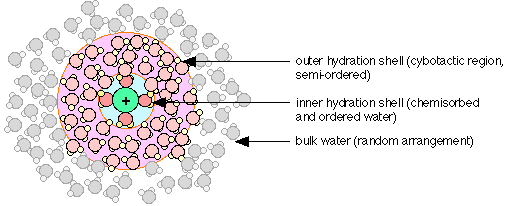
Some contempo experiments have revealed a degree of covalent bonding between the d-orbitals of transition metal ions and the oxygen atoms of h2o molecules in the inner hydration shell.
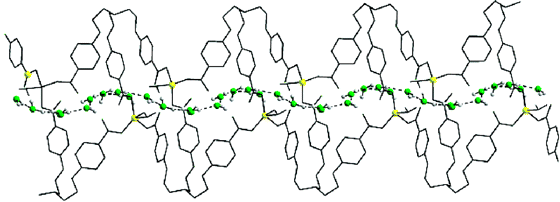
In 2003, some chemists in India found (Inorg. Chem. 44(4) pp 816 - 818) that a suitable molecular backbone (above) can cause h2o molecules to form a "thread" that can serpent its manner though the more open space of the larger molecules. What all of these examples show is that h2o tin can have highly organized local structures when information technology interacts with molecules capable of imposing these structures on the h2o.
Finally, a 2006 publication from U. Nebraska-Lincoln describes how water can class a DNA-like double-helix within a carbon nanotube that is subjected to high pressure.
Biowater: Bound water in biological systems
It has long been known that the intracellular water very close to whatsoever membrane or organelle (sometimes called vicinal water) is organized very differently from majority h2o, and that this structured water plays a significant role in governing the shape (and thus biological activity) of large folded biopolymers. Information technology is important to comport in heed, however, that the structure of the water in these regions is imposed solely by the geometry of the surrounding hydrogen bonding sites.
Water tin can hydrogen-bail not just to itself, merely also to whatsoever other molecules that accept -OH or -NHii units hanging off of them. This includes elementary molecules such as alcohols, surfaces such equally glass, and macromolecules such as proteins. The biological activity of proteins (of which enzymes are an important subset) is critically dependent not only on their composition but also on the way these huge molecules are folded; this folding involves hydrogen-bonded interactions with h2o, and also between unlike parts of the molecule itself. Anything that disrupts these intramolecular hydrogen bonds will denature the protein and destroy its biological activity. This is essentially what happens when you boil an egg; the bonds that concur the eggwhite poly peptide in its meaty folded arrangement break autonomously so that the molecules unfold into a tangled, insoluble mass which, like Humpty Dumpty, cannot be restored to their original forms. Note that hydrogen-bonding need non always involve water; thus the two parts of the Dna double helix are held together by H—N—H hydrogen bonds.
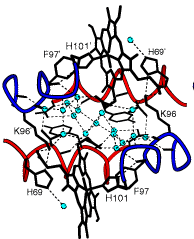 This epitome, taken from the work of William Royer Jr. of the U. Mass. Medical Schoolhouse, shows the water structure (small dark-green circles) that exists in the space between the two halves of a kind of dimeric hemoglobin. The thin dotted lines represent hydrogen bonds. Owing to the geometry of the hydrogen-bonding sites on the heme protein backbones, the H2O molecules within this region are highly ordered; the local water structure is stabilized past these hydrogen bonds, and the resulting water cluster in turn stabilizes this detail geometric form of the hemoglobin dimer. More diagrams, with commentary, can be found hither.
H2o Pseudoscience
See the "AquaScams" site for much more on this bailiwick. Hither are a few highlights.
Gerald Pollack and "EZ" water
Prof. Pollack of the University of Washington, inspired by the remarkable work of Gilbert Ling, has written extensively on his studies of water in the region of a hydrophilic solid such as a living cell. His work suggests that solutes (i.e., dissolved substances) are systematically excluded from such zones, and has coined the term "EZ-water" (exclusion zone water) to describe this miracle.
I respect the research that Pollack has published in reputable peer-reviewed journals, simply some of his conclusions do seem to be at odds with conventional scientific consensus, and it is certainly true that his interpretations have prompted a lot of criticism from both the chemical science and biology communities. Judging from some of the comments I accept seen, it will likely exist a while before in that location is enough bear witness to back up or refute his theories.
Cells, Gels and the Engines of Life : A New, Unifying Approach to Jail cell Office is the title of a fascinating, beautifully illustrated book past Gerald Pollack of the University of Washington. His central theme relates to the structuring effect of the water molecule on the dynamics of the cytoplasmic gel. As with most theories that challenge conventional scientific agreement, Pollack's ideas take attracted a lot of criticism from the scientific community (example), but as this review in Nature suggests, there is a lot here that is certainly worth exploring.
Prof. Pollock'south 2022 volume, The Fourth Stage of H2o, is as beautifully written and illustrated as his before one. And information technology will probable evidence every bit controversial, firming upwardly the author's reputation (at least amid some chemists) as "The Bad Male child of H2o Science". The publisher offers a gratuitous pdf file containing several capacity.
However, I am troubled by some of the more contempo stuff he has put on YouTube; publicizing "scientific" results to the general public before offering them or comment and criticism by scientific peers has led to the downfall of many scientists (e.thousand., "polywater" and "cold fusion".)
"Clustered", "Unclustered" and other structure-altered waters
Unfortunately, a lot of snake-oil hucksters have been falsely implying that their nonsensical claims are supported by Pollack'south work.
 The "alternative" health market is total of goofy products which purport to alter the structure of h2o by stabilizing groups of HtwoO molecules into permanent clusters of 4-8 molecules, or alternatively, to break upwards what they claim are the larger clusters (usually 10-15 molecules) that they say unremarkably be in h2o. The object in either instance is to promote the menses of water into the body'due south cells ("cellular hydration"). This is of course utter nonsense; there is no apparent scientific bear witness for any of these claims, many of which verge on the baroque. In that location are even some scientifically absurd U.South. Patents for the manufacture of and so-chosen "Clustered Water™". At to the lowest degree 20 nostrums of this kind are offered to the scientifically-naïve public through hundreds of Web sites and belatedly-night radio "infomercials". None of this misleading sales hype should exist believed.
Does water take "memory"?
According to modernistic-day proponents of homeopathy, information technology must. Homeopathic remedies are made by diluting solutions of various substances then greatly that non even a single molecule of the active substance tin exist expected to exist present in the last medication. Now that even the homeopaths have come to accept this fact, they explicate that the water somehow retains the "imprint" or "retention" of the original solute.
In 1985, the belatedly Jacques Benveniste, a French biologist, conducted experiments that purported to show that a certain blazon of cellular allowed response could be brought about by an anti-immunoglobulin agent that had been diluted to such an extent that it is highly unlikely that even one molecule of this agent remained in the aqueous solution. He interpreted this to bespeak that water could somehow retain an impression, or "retentivity", of a solute that had been diluted out of existence. This result was immediately taken past believers in homeopathy as justification for their dogma that similarly diluted remedies could be effective as alternative medical agents. The consensus among chemists is that whatever temporary disruption of the water structure by a dissolved agent would disappear inside a fraction of a second after its removal by dilution, attributable to the vigorous thermal motions of the water molecules. Benveniste'south results take never been convincingly replicated by other scientists .
In 2010, a Uk parliamentry commission written report urged the government to withdraw funding and licensing of homeopathy.
Can y'all run your car on water?
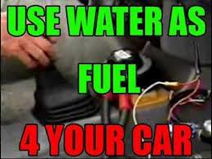 Not really. For water to act as a fuel, there must exist some combination of oxygen and hydrogen that is energetically more stable than H2O, and no such molecule is known.
This fact has failed to put to residuum the venerable urban legend that some obscure inventor discovered a process to exercise this, but the invention was secretly bought upward past the oil companies in order to preserve their monopoly.
It takes 286 kJ of energy to interruption upward 18 yard of water into its elements. Allowing the oxygen and hydrogen to recombine yields this aforementioned corporeality of energy back in the form of heat. But to do annihilation useful with this heat, it must be converted into work, and the Second Law of Thermodynamics limits the efficiency of this stride to less (commonly far less) than 100%. If the hydrogen and oxygen are recombined in a fuel cell, the 2nd Constabulary limitation is removed, simply the First Law all the same limits free energy recovery to 100%, and this does not count inefficiencies in the initial decomposition of water. Any scheme to decompose water into hydrogen and oxygen requires a cyberspace input of energy.
Nonetheless, adding water to the fuel-air mixture in an internal combustion engine, a process known as water injection, has been employed for many years as a method of improving the functioning of both piston- and turbine engines. H2o injection kits are widely available, many offered by hucksters whose marketing (sample) falsely implies that their products let y'all to "run your car on water". Don't believe it! And get some solid advice before you endeavour this on a modernistic computer-controlled high pinch engine.
Called-for h2o
In 2007, a widely-cited YouTube video appeared that showed a sample of salt water "burning". This occurs simply in the presence of a strong radio-frequency field, which supposedly dissociates the water into H2 and O2. These two gases then recombine, producing the flame. Although there has been much uninformed hype nearly this existence some kind of a breakthrough equally a source of "energy from water", there is no reason to believe that the Starting time Police force of Thermodynamics has been repealed. If the energy supplied past the radio-frequency source is taken into account, you can be sure that there has been no net free energy gain.
The bodily mechanism of the process remains unclear. The fact that salt or another ionic solute is required suggests that ions at the water's surface might be accelerated in the local field produced by the plasma discharge, helping to break up the molecules in the h2o vapor.
But for something really far-out, few things vanquish the sub-culture of the "gratuitous energy" pseudoscience enthusiasts and their religion-similar obsession with "HHO" (too known as "Brown's gas") for whom the belatedly Stan Meyer seemed to be the guru.

References
The mystery, fine art and scientific discipline of h2o. This site provides a view of water in all the many means it impacts upon the multiple facets of our culture. Highly recommended.
Water Treatment - this Wikipedia page covers the basics of water handling and disinfection.
Water Construction and Backdrop is a Spider web site developed by Martin Chaplin at South Bank Academy in England. It is a scientifically sound, well laid-out drove of manufactures on h2o and its structure which should respond any of your questions.
Does hot water freeze faster than cold water? Yes, this tin happen under the right conditions. Brief explanation, more than consummate explanation. Run into too Warm water vibrates for a longer fourth dimension.
Special Report on the Chemistry of H2o from the U.S. National Science Foundation. An interesting summary of new work on water and its structure, with some striking images.
"Water Buckyballs": Chemic, catalytic and cosmic implications. This rather technical newspaper by Keith Johnson of MIT explores the breakthrough theory and far-i.r. spectra of water clusters and speculates on their role in cosmochemistry.
{The structure of ideal liquid water} - a well-organized but rather technical Web site by Gregory Moreno. Information technology includes an extensive bibliography of scientific articles on water construction from 1915 through 1992.
Water on earth: the hydrosphere and the oceans - this site, from the Author's quondam grade in Environmental Chemistry, presents a full general survey.
Why is water blue? It's all almost O-H bond stretching! A more than technical site. See also this nicely illustrated NASA article Where is the ocean bluest?
For a darker view of water, see the Ban DHMO page
and finally...
Science tells us about the world, but the arts help us observe ourselves. Here are a few water-related artistic works that I would similar to share:
| (click on prototype for enlarged view) | (click on image for enlarged view) | (click on paradigm for enlarged view) |

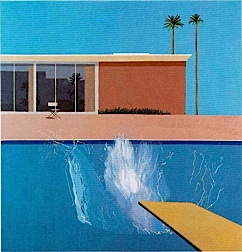
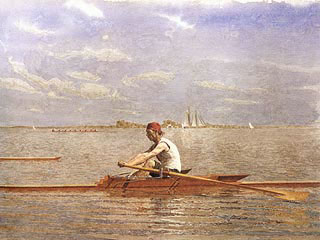
| | | |
 Bedřich Smetana'south Vltva (a section of his symphonic poem Má vlast) follows the course of the Moldau River from its mountain spring, down through "Bohemia'south meadows and forests", to its triumphal arrival in Prague, where information technology forms the setting to the High Castle.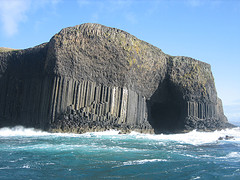
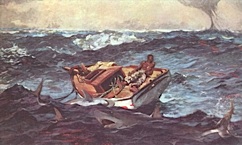
Source: https://www.chem1.com/acad/sci/aboutwater.html
0 Response to "Can Liquid Water Form Lasting Structures Consisting of 6, 12, 13, 16 or More Molecules?"
Post a Comment