How to make an ePortfolio: a guide for students & teachers
Last Updated on December 21, 2021
A growing number of visual art students now present their work in an online 'ePortfolio' or 'digital sketchbook'. Digital presentation methods have grown in popularity, due to the recent ascent in altitude/remote learning, and the increase in digital media within classrooms. A 2022 study, which examined how digital technology was used past fine art teachers, noted that "the emerging theme from the electronic resources code was digital portfolios."[5] Here nosotros outline the benefits of digital presentation and explain how to create an ePortfolio for students, illustrating some of the best ePortfolio strategies used past high-achieving art students from around the world.
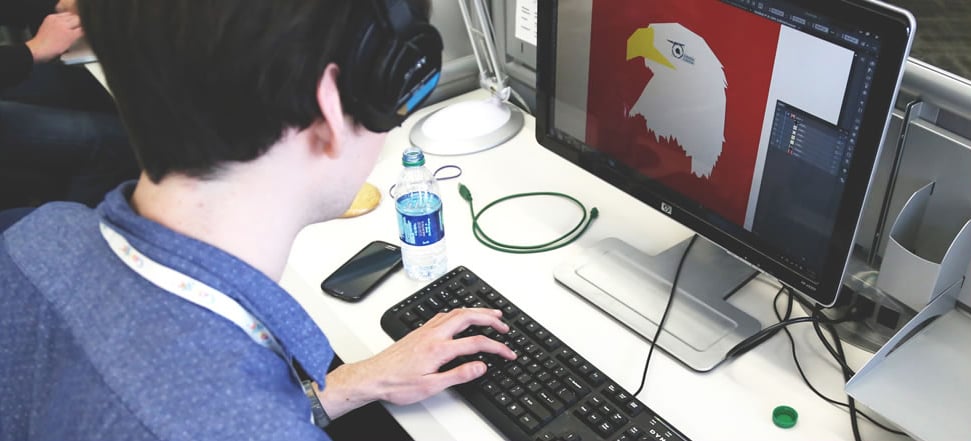
What is in this guide? An index:
- What is an ePortfolio?
- Why are ePortfolios beneficial for art students in item?
- Things to consider before creating an ePortfolio with students
- ePortfolio layout and organization tips
- Choosing a platform: requirements for students
- Digital tools and platforms: the best online portfolio sites for students
- Bibliography
ePortfolio definition: The word 'ePortfolio' is shorthand for 'electronic portfolio,' and is sometimes known as an e-portfolio, eFolio, iFolio, spider web-page, digital sketchbook, digital portfolio, or online portfolio. Information technology is a place to brandish creative piece of work online (artwork, photographs, videos, designs, writing, and and then on), and may include hyperlinks, headings, navigation menus, and pages combining visual material and text.
ePortfolios in education: Electronic portfolios for students provide a place for students to tape their learning, so that material tin can be accessed remotely by a teacher, classmates and others. Student ePortfolios document learning over fourth dimension, and provide a place to store, analyze and reflect upon work.
An electronic portfolio (e-portfolio) is a purposeful collection of sample student piece of work, demonstrations, and artifacts that showcase student's learning progression, accomplishment, and evidence of what students tin exercise.
Center for Teaching & Learning, Berkeley, University of California[1]
In many cases, high school art students use ePortfolios in a like way that is similar to a traditional art sketchbook with visual imagery displayed alongside typed annotation.
ePortfolio development involves trouble solving, decision-making, reflection, organisation, and disquisitional thinking by students developing a learning 'story' that accurately represents skills learnt and competencies developed.
Dawn Bennett, Diana Blom, Peter Dunbar-Hall, Matthew Robert Hitchcock, Jennifer Rowley, ePortfolios for Creative Arts, Music and Arts Students in Australian Universities (2015) [2]
A well-executed due east-portfolio program is an incredible tool for higher education. They provide institutions with accurate assessments of educatee learning and promote the deeper learning that nosotros want for our students.
Candyce Reynolds, Associate Professor, quoted inside The Benefits of E-portfolios for Students and Faculty in Their Own Words, Peer Review, Vol. eleven, No. one (2009)[3]
Although it is well known that artists and designers benefit from displaying their work online (see our guide to creating an artist website for more data about this), ePortfolios offer specific advantages to art students in particular:
ePortfolios can transmit sound and moving epitome
One of the best attributes of an ePortfolio is that, dissimilar traditional paper-based presentation methods, they tin can include audio files, animated images (such as GIFs), and video footage, assuasive the communication of ideas via sound and move. As such, ePortfolios are particularly popular among students who specialize in filmmaking, digital photography, web design, blitheness, app pattern, game design, and complex multi-media work. Even those specializing in painting and cartoon and other two-dimensional formats are able to prove videos of work-in-progress, sound presentations, and so on, communicating in ways that are not possible with traditional methods.
Creating an ePortfolio promotes digital literacy and web pattern skills
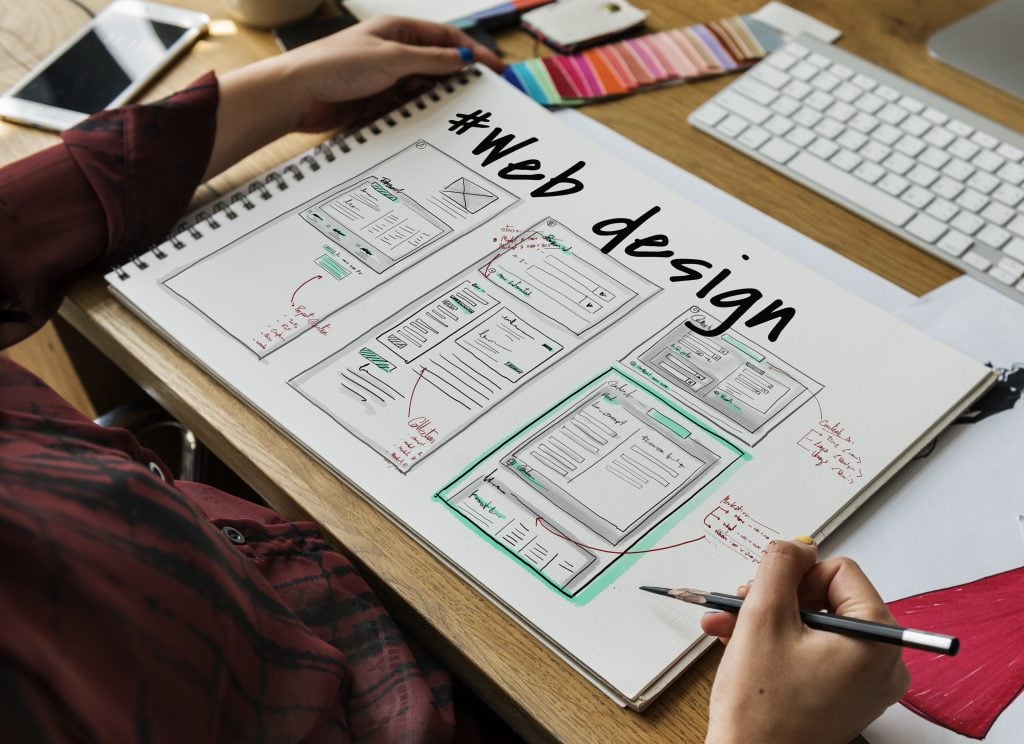
Many students already create logo designs and other graphic design outcomes as office of their loftier schoolhouse art programs: website pattern is a natural extension of this, with options to design the site layout, graphics and font. Many high school qualifications take updated their curriculums to specifically include digital learning. For case, the Cambridge International AS and A Level Digital Media and Design syllabus recently added the following area of report: "Mobile and multimedia applications include spider web and mobile applications, games, interactive media and digital installation." This syllabus, as do nearly high schoolhouse programs, includes many topics that could form role of an ePortfolio or web design project.
Here is an example of a final website design past a high school pupil in New Zealand:
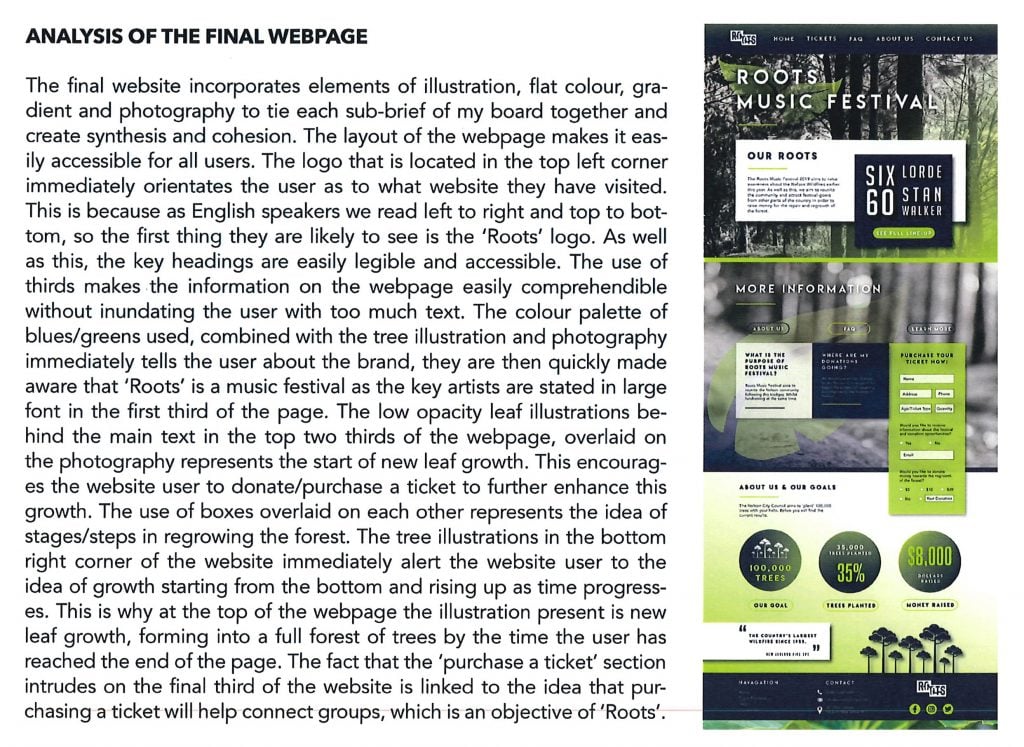
In other words, edifice an ePortfolio is not simply an alternative way of presenting artwork, but can be an integral mode of coming together curriculum requirements, providing "an assessment mode that is more than relevant to current and futurity students in the 21st century."[iv]
Even creating a simple digital portfolio to display student work offers numerous transferrable skills. For example, it encourages the use of scanners, video cameras, and other digital tools, as well equally editing software, such as Adobe Photoshop. It besides introduces students to spider web design or blogging software (come across beneath for a detailed discussion on the dissimilar ePortfolio platforms that are recommended for students). Having these skills gives students a leg upwards, regardless of the field they end upward entering.
ePortfolios reduce printing and reproduction costs
Graphic design and photography students typically face very high printing costs, with students having to impress out material for every cess. Combined with the cost of a camera and software licenses, this tin make such courses prohibitive for many students. Presenting piece of work via an ePortfolio, withal, eases this burden dramatically. When piece of work is shared and assessed electronically, printings costs tin can be reduced significantly, with printing merely taking place for concluding submission or exhibition pieces, for instance. This also avoids the rush of 20-xxx students queuing for the printer, and is environmentally friendly to kicking.
Work can be viewed remotely, without transporting of bulky physical items required
ePortfolios are non only helpful for those studying digital arts, but those specializing in more than hands-on disciplines, such every bit cartoon, painting, sewing, fabric blueprint, sculpture and 3D Pattern. With confront-to-face learning currently disrupted in many parts of the globe, having a streamlined electronic system for displaying and sharing pupil work is helpful, particularly when traditional sketchbooks, art supplies, and finished artworks are often bulky and hard to send. Even in ordinary circumstances, a mixture of digital and difficult-copy submission can help with space, storage and transportation bug in decorated classrooms.
We have kids upload photos of their artwork and exercise essays and critiques, that mode and then that there is a lot less paper to behave around, a lot less trying to shop artwork with that many students since we have such a big department and classroom space is limited.
Anonymous high schoolhouse teacher, quoted by Jesse Strycker, K-12 Art Teacher Engineering science Use and Grooming, ScienceDirect (2020)[5]
Work can be viewed by many people at whatsoever time, fostering constructive critique and in-procedure feedback
Many ePortfolio platforms have comment functionality built in, allowing students and teachers to offering productive written feedback (comment functionality can be switched off, if moderation becomes a problem). This is particularly successful with students who are less confident about providing verbal feedback in form. Teachers note that many enjoy the low-pressure level nature of sharing critique online.
Accessing work via an ePortfolio, without the student needing to be present, likewise allows teachers to provide private formative feedback more readily than is always possible in a busy classroom situation.
The process of giving and receiving feedback was rapid and easy, and meant students were able to obtain more private feedback than had previously been possible, and in a timely fashion, increasing its effectiveness (Gibbs, 2010).
Dawn Theresa Nicholson, Enhancing student engagement through online portfolio assessment, Practitioner Research in Higher Education (2018) [4]
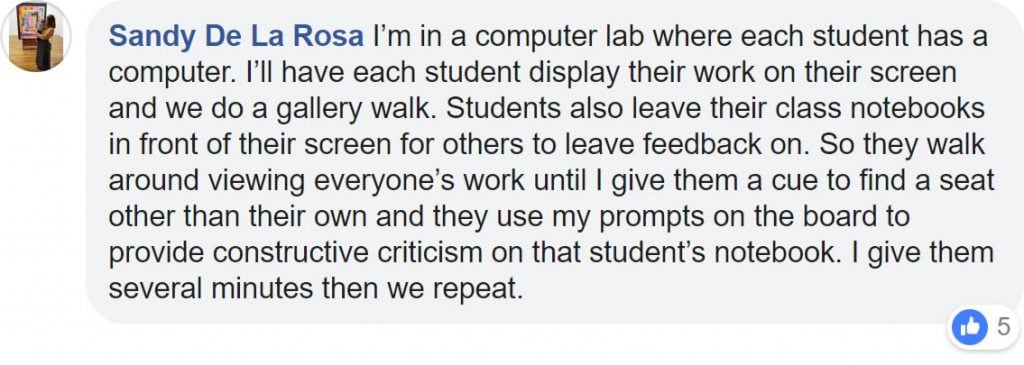
Within classrooms, ePortfolios tin can be projected onto a large screen, or viewed on individual computers, as Sandy De La Rosa describes:
ePortfolios can increase pupil engagement
An interesting study[four] recently compared 2 groups of university students, both of whom were asked to consummate the aforementioned tasks. I grouping had to submit their work via a paper-based portfolio; the other via an ePortfolio. (This study ran across 2 years, with over 200 students in total, randomly split into groups). Teachers made the important ascertainment that those who completed an ePortfolio were less likely to go out their work until the concluding minute. It was suspected that this was because students knew that their teachers would periodically await at their ePortfolio, but never knew exactly when, and then they worked more regularly to keep their portfolio updated, just in case the teacher checked information technology. Teachers as well noted that classroom discussions were often more productive, because "students had already read and acted upon feedback."
Students made progress on their portfolios week by calendar week instead of leaving it all to the stop. This was because they knew their sites were going to get displayed the following week…. and also considering they knew I was looking at their sites and prodding them if they hadn't done the piece of work.
Anonymous tutor, quoted by Dawn Theresa Nicholson, Enhancing pupil date through online portfolio assessment, Practitioner Inquiry in Higher Education (2018)[4]
In a high school setting, information technology is not just the teacher who might viewing and annotate upon an ePortfolio in real-time, simply classmates, parents, and peers. This increased feedback can result in increased levels of engagement. This finding is backed up past another 2022 study which found that ePortfolios promoted an "increase in student appointment and communication with the added benefit of connected learning in the secondary art classroom."[six]
ePortfolios can double equally a career portfolio, improving employment prospects
Many art students earn money from creative pursuits while studying, such as offering photography services, videography, or painting portraits for friends and peers. If an ePortfolio is ready during high school, it can assistance students marketing their skills and achievements to potential clients and employers. An ePortfolio of this nature could include a resume and artist argument, alongside collections of artwork. (Please note that students should be very conscientious about uploading contact phone numbers and other identifying details – see our word about internet safety beneath.)
In fact, ePortfolios are considered and then valuable for university students, that many institutions now require students to create these as part of their course[7] – in a broad range of disciplines, from teaching/instruction, music, to science.
…more than than four in five employers say an electronic portfolio would be useful to them in ensuring that job applicants have the knowledge and skills they need to succeed in their company or system.
Hart Enquiry Assembly, It Takes More than a Major: Employer Priorities for College Learning and Educatee Success (2013)[8]
Senior high schoolhouse students who are actively looking to enroll in college or university (meet our guide to creating an application portfolio for college or academy) can hence find creating an ePortfolio an excellent mode to link learning to real-world goals.
[At] an urban high schoolhouse in northeastern Georgia, students often complained nearly their perceived disconnection between classwork and the value of these assignments beyond high schoolhouse; students made frequent remarks about ELA assignments similar, "I'll never have to do this after loftier school." Because of these concerns, the researcher implemented an ePortfolio with a reflection on transferable skills as an intervention to help students reflect on the transferable skills expert inside high school coursework and its value in their future endeavors in college or a career. …[]… Findings from both the quantitative and qualitative information revealed that the ePortfolio with a reflection on transferable skills positively affected high schoolhouse students' perceptions of college and career readiness in their high school.
Julie Beatrice Kristin, I'll Never Take to Exercise This Subsequently Loftier School: Exploring Students' Perceptions of College and Career Readiness and the Effects of Eportfolios With Reflection on Transferable Skills (2020)[ix]
ePortfolios tin can be used as promotional tools within the wider schoolhouse and community
Parents and school management teams are often impressed at the professional person appearance of student ePortfolios. Online material tin can be projected onto big screens at open days and career nights, providing a 'virtual window' into the classroom, offer great marketing opportunities for the Fine art & Blueprint department. Links to student ePortfolios can exist made available from the school or teacher websites for similar reasons. Links to ePortfolios by past students can likewise showcase outstanding performance in various creative fields.

ePortfolios tin streamline the grading process, collating work in a single location
Fine art teachers sometimes feel like tearing their hair out attempting to assess student work that is scattered beyond several locations (a finished video prune on YouTube; obscurely labelled files in online folders; hardcopy drawings in a sketchbook; items on a misplaced pollex drive; and over-sized files attached via email). This can go a logistical nightmare when collating and assessing piece of work from hundreds of students.
An online ePortfolio acts as a central hub, collating all work by a single student in 1 location (YouTube videos can exist embedded, image files uploaded, annotation added straight aslope, and even concrete artworks tin can be scanned an added).
Each separate consignment of sub-unit of piece of work can be presented upon a unmarried ePortfolio page, with the instructor scrolling upwards or downward as required to view the entire submission. With this method, each pupil 'submits' only a single link for assessment. Inboxes are not chock-full; files do non need to be painstakingly opened i at a time. The teacher opens the appropriate link, and the unabridged submission is visible – images, multi-media, and text, arranged upon a single portfolio page.
Although critiquing student work from single ePortfolio page is often non as simple every bit assessing hardcopy piece of work directly in front of you lot, it is far meliorate than other digital alternatives. It likewise has the advantage that teachers don't need to carry armloads of piece of work to-and-from school, and can grade anywhere that they have internet access. This submission technique too allows regular formative feedback to be given via comment features, as described in a higher place.
Updating and modifying work is easy
A digital portfolio can exist edited, improved and updated equally the course progresses, providing a flexible digital document to accompany hardcopy sketchbooks.
Students have been stuffing assignments in notebooks and folders for years, so what's and then new and exciting nigh portfolios? Portfolios capitalize on students' natural tendency to save work and become an effective fashion to get them to take a 2d look and recall near how they could improve hereafter work. As any instructor or student can ostend, this method is a clear departure from the one-time write, hand in, and forget mentality, where commencement drafts were considered terminal products.
David Sweet, Student Portfolios: Classroom Uses, Education Research Consumer Guide (1993)[ten]
At that place are several issues to consider before creating an ePortfolio with high school students, particularly if this is to be alive on the internet, attainable by the public. (Near ePortfolio platforms have the power to set these as either public or private.)
Net safety and privacy: seek parental permission and ensure no contact details are included
Sharing work online involves potential complications with internet prophylactic and privacy. It is vital that students and their families consent to sharing of work via the digital platform and understand what the ePortfolio volition involve. Teachers should familiarize themselves with school policies around sharing student work with tertiary parties.
Students should ensure that phone numbers, age, addresses and other identifying details are not included within their ePortfolio. If creating an ePortfolio for marketing purposes, where students want to encourage potential clients, a 'contact form' should exist used, rather than making an email address publicly visible (automated bots crawl the net 'harvesting' email addresses, so that they can be sold to others for spam email purposes, and so publishing an email addresses online is not brash).
Some schools request that students practise non include their full name, and use only an initial for their surname, all the same, a full name can be helpful for building an online presence, then every bit long as no contact details are included, this is ordinarily okay.
Ensure content is advisable for a classroom situation: respectful language, inoffensive imagery
One of the most important things students must understand earlier posting content to an online ePortfolio is that what goes online, stays online. It is good exercise to assume that everything published on the internet (whether to social media, a 'private' Facebook group, your own ePortfolio, or otherwise) might be seen past vast numbers of people, and that, once uploaded, you may never exist able to remove it or undo information technology. Numerous automatic robots, as well as humans, re-create and indistinguishable digital material, and sometimes the well-nigh unexpected content goes viral. Furthermore, the 'WayBack Automobile' takes permanent snapshots of web pages, archiving the cyberspace, so that web pages tin be accessed at a later date even if the material is later taken offline. In short, one time material is uploaded to the internet, information technology is oft in that location permanently, and the original uploader loses control over how it is used or shared. In rare cases, you can speedily delete textile before anyone else has seen information technology, but you should not count on this. Even isolated comments on someone else's website may come back to haunt, as this man discovered:
…he has commented on someone else'due south post and been very offensive towards them. His comments were rude and ill idea out, and were made some six years agone. He has now realised his comments can be found in Google when a search is made for his proper name – something he didn't think would happen when he made the comments.
Darren Jamieson, What happens online stays online (2016)[11]
Questionable content posted online can compromise students not just in the nowadays, simply in the futurity – in unanticipated ways. For this reason, schoolhouse administration / direction are more than probable to get involved if objectionable content is shared with an ePortfolio than had the aforementioned textile been shared in a hardcopy classroom sketchbook – considering the ramifications are much more than serious.
It is worth remembering that about students share content online on a regular basis anyhow, and will continue to do so, whether they are granted permission to create an ePortfolio as part of a schoolhouse projection or non. Hence, this task provides an excellent opportunity to assist students develop responsible strategies for communicating online.
Protect confronting plagiarism
If work from artists or other individuals is included or quoted within an ePortfolio, this should exist formally referenced, every bit within any other academic project.
At that place is sometimes the worry that students from one school might plagiarise the work of students from some other. Some teachers get around this by having the online portfolio as an end-of-year projection that takes place after work after has been formally submitted – or by having the portfolios accessible online, just non discoverable by search engines, so that the ePortfolio cannot be hands found past others (the portfolio can so exist made public in one case the course is complete). Information technology is worth noting, still, that many high schoolhouse art projects are inspired past multiple practising artists, with ideas developed under the guidance of a teacher in original directions. Hence, mimicking of artwork past single student is hence non commonly a major concern.
Verification of ownership: Include screenshots of work in progress and accompany digital submissions with concrete artwork
Many qualifications require a school or principal to verify the actuality of educatee work before it is submitted for external assessment. This can be more challenging when work is submitted digitally, because it is harder to know whether work has been copied from elsewhere. For this reason, students should document work in progress – showing screenshots at diverse stages of completion.
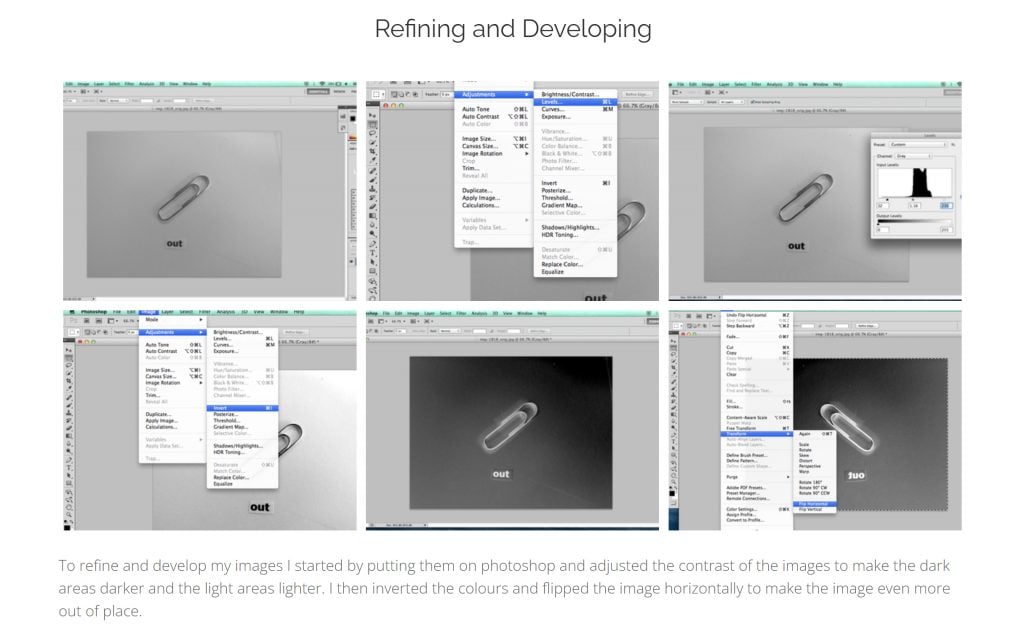
Information technology is also helpful to accompanying digital submissions with hardcopy sketchbooks or artwork, to aid to verify buying of digital work.
Remainder screen time with easily-on creation
There are valid concerns well-nigh the number of hours young people spend online – something that is but escalating with the lockdowns taking identify in many parts of the world. Long hours online and the distraction of social media can affect mood and sleep, compromising productivity and quality of work overall. This is an important consideration when making a option about what office an ePortfolio will play in the classroom.
There is an immediacy and joy in creating easily-on artwork that is sometimes lacking when interfacing between keyboard and screen. Art students often love the run a risk to collaborate with physical media, using their hands to create things – experiencing surface and texture and touch. Creating physical artworks allows the spontaneous transfer of ideas by hand, and strengthens and consolidates practical fine art-making techniques.
For this reason, students might choose to delay ePortfolio cosmos until the senior years of high school, leaving the earlier formative years to focus predominantly upon applied art-making skills. Fifty-fifty senior students creating digital art courses benefit from sketching and experimenting with physical media alongside the creation of an digital work (this also helps with verifying ownership of work, as noted above).
Backup the ePortfolio
Digital files used within an ePortfolio should be stored on a retention stick or cloud server (an automatic backup service, such equally Dropbox, is recommended). It is also wise to print a copy of each ePortfolio page. These printouts can exist bound and submitted so that examiners have a physical copy in case of technological difficulties.
Not all teachers notice assessing student ePortfolios straightforward – with some commenting that it sometimes feels like a "wild goose chase" to locate the appropriate item for assessment.[four] The procedure is much easier if teachers use a consistent form-wide ePortfolio structure and folio-labelling, equally this enables teachers to navigate directly to the appropriate page in each student'south ePortfolio without hiccup.
In the evaluation, staff expressed strong feelings virtually the marking procedure. For some, the process was much improved, while for others, more challenging. The divergence appeared to chronicle largely to the organisation, structure, and formatting of students' web sites:
How well the students set the WordPress site, and how they chose to post their portfolio elements, made a significant difference to how like shooting fish in a barrel information technology was to review work.
Dawn Theresa Nicholson, Enhancing student engagement through online portfolio assessment, Practitioner Research in College Education, Vol. 11, No. 1 (2018)[4]
At that place are no fixed rules about how to fix an ePortfolio, nevertheless most good ePortfolios use a similar layout and organizational structure. This helps teachers and assessors navigate around the site and view the work without difficulty.
If the purpose and assessment criteria of portfolio are not articulate, the portfolio can be only a miscellaneous drove of works that can't reflect students' growth or accomplishment accurately.
Adnan Baki, Osman Birgin, The Use of Portfolio to Assess Educatee'south Performance (2007)[12]
Brand a new page for each assignment or unit of measurement of work
Students should not haphazardly dump piece of work within the ePortfolio, nor space work out beyond hundreds of disconnected pages. It is advantageous to publish each consignment or unit of work on its ain page, integrating artist research, notation, reflections, and collections of images and ideas in the one location. This allows the marker to curl up and down to assess the piece of work, without having to click back and forrad betwixt multiple pages. (This is good practice for professional career ePortfolios too, as having more content on a single page makes it easier for Google to understand what each folio is about and helps drive traffic to your website – more than tips for growing traffic to an artist website will discussed in an upcoming article).
Include a carte, with clearly labelled navigation links

Include a navigation carte du jour at the acme of the screen (to a higher place or below the primary heading) with links to unlike sections of piece of work inside the ePortfolio. A drop-downwardly menu can be used to group pages together in categories and sub-categories. The menu should utilize clear, easily-understood wording. Teachers ofttimes have specific rules and naming protocols for carte items, so that they tin can locate work without difficulty.
Carte items should be ordered sequentially, to show progression of ideas, and should include a link to the home page, and other cardinal pages (such every bit an 'About Me' and 'Contact' page, which are useful for those wishing to utilise the ePortfolio for career purposes). A 2nd carte tin can as well be included in the footer of the site (at the very bottom of the page).
Ensure content views well upon unlike screen sizes, with images and text conspicuously visible
Sometimes as a browser resizes, images and text leap positions, and so that what worked well on ane screen does not view well on another. Students should resize their browser and view on dissimilar devices, to check how the work displays at other screen sizes.
It is hard for examiners to assess work when only part of an image is visible at one time. Remember that examiners are likely to assess student work upon a desktop. If yous accept tall, narrow artwork, reduce the file size and so that the unabridged artwork is visible on a single horizontal screen. If fine details are not visible at this scale, carve up photos tin be added showing close-upwardly details.
When annotating artwork, it is helpful if the images are visible on the screen at the same time every bit the text, so it is clear which images are being discussed.

Apply hyperlinks to connect dissimilar parts of the portfolio and link to external websites
Hyperlinks play an important role in helping Google's search algorithm understand online content, and help an ePortfolio exist visible in search engines – often an important goal for students wishing to grow their online presence and develop an art career. Hyperlinks also help teachers and assessors navigate their way around your site.
When referencing work from others, it is practiced etiquette to link to the original source, so that those wishing to seek more information can click through and visit the appropriate website.
Apply a simple presentation manner
A artistic ePortfolio is more than simply a place to dump work – the presentation matters. Put thought into color and font selection, aiming for like shooting fish in a barrel readability. When arranging content on pages, retrieve that overcrowded work or tiny font sizes may make it difficult for examiners to appraise work. As with a traditional sketchbook, a make clean, minimalist aesthetic is desirable, every bit this does not distract from the artwork (more ideas about presentation tin can be institute in our guide to creating an outstanding high schoolhouse sketchbook).
Introduce the project on the 'Domicile' page
The front end page of the ePortfolio is probable to be the kickoff affair that an examiner will encounter. Use this equally an opportunity to summarise the project and outline the purpose of their ePortfolio, adding links to the unlike key areas of the project.
Add an 'About Me' page
An About Me folio is particularly important in the example of a career portfolio. Students can add information almost themselves here, including the creative services they offering. Students may also include a photograph of themselves (many cull to have the face obscured or hidden for privacy reasons).
Hither is part of the text used on an Most Me ePortfolio example by a college student seeking to promote her work and gain clients:
Hello and welcome! I'm glad y'all're here!
My proper name's Carter Teal, possessor and master photographer of Carter Teal Photography! I'1000 currently a college student at The Ohio State University pursuing a field in their Pattern program. I'm based in Key Ohio and I shoot weddings, couples, portraits, families, and much more!
Carter Teal, Carter Teal Photography
When selecting where to make an ePortfolio with students, the following should be considered:
The ePortfolio should exist portable, so students can employ information technology across graduation
Ideally, student ePortfolios should not be tied to school systems, and so they are accessible one time students have left school – making them helpful for both higher and university applications, and beyond. Although material can be manually copied and paste fabric from in-firm platforms for future use, doing this at scale, with multiple students is impractical.
The case was made that PGCE students would be inbound the earth of piece of work the following twelvemonth and therefore should have immediate access to their portfolios equally continuous professional development tools…
Magda Barnard and Sonja Strydom, A tale of two faculties: Exploring educatee experiences of eastward-portfolio implementation as a vehicle of reflective learning at Stellenbosch Academy, The Contained Journal of Teaching and Learning, Vol. 12, No. ii (2017)[13]
The platform must be reliable, robust, and secure
A stable, well-established digital platform is essential. The longer a platform has been operating, with an active user base, the more likely it is to be secure, without bugs and technical issues. Pop platforms are also accompanied by a huge array of tutorials and grooming videos to aid when students get stuck.
The platform must exist simple to use
Immature people are often described every bit 'digital natives', notwithstanding a platform used with loftier schoolhouse students must cater towards all skill levels and exist sufficiently direct forward and user-friendly.
…despite engaging with so-chosen 'millennials', it was clear that the assumption could not exist made that all the students were comfy with the required technologies and that they knew how to utilise them equally expected. …[]…most of the cohort asked for a more than hands-on training experience related to multimedia skills (due east.thou. adding images, videos and sound clips) and granting admission to their respective portfolios at the start of the projection…
Magda Barnard and Sonja Strydom, A tale of two faculties: Exploring student experiences of e-portfolio implementation as a vehicle of reflective learning at Stellenbosch University, The Independent Periodical of Teaching and Learning, Vol. 12, No. 2 (2017)[thirteen]
The platform must be flexible and customizable
Art students are keen to add together their own marking to their creations. This is particularly critical if students promise to use an ePortfolio for enhancing their career after graduation. The best ePortfolio platforms allow room for self-expression, selecting different layouts, fonts, colors and so on.
The platform should have comment functionality
As noted above, engagement is often driven by comments and responses from teachers and classmates. Yous may wish to ensure information technology is possible to switch comments on and off, every bit desired.
The platform should exist complimentary or inexpensive to employ
Costless ePortfolio websites for students are popular for obvious reasons, notwithstanding these come with downsides that must be considered besides. Some schools employ savings made in printing budgets to cover costs of high-quality ePortfolio platforms. Both paid and premium options, with their pros and cons, are discussed below.
It can be helpful to apply the same platform school-wide
If you are creating ePortfolios within the classroom, having all students select the aforementioned platform makes educational activity and grading more efficient. Teachers tin can employ a mutual set of resource between year levels (some teachers also create their own website using the same platform, modelling good practice for students and learning how to apply the platform together). A school-broad policy means that students all become familiar with the same platform – and so changing classes and year levels doesn't involve relearning how to apply some other platform all over again.
When students spend more than one year working with digital portfolios, they learn and know the tool. This means students aren't bogged down with learning the technical stuff. They will become fluent with the engineering and exist able to concentrate on creation, curation, reflection, connections, and all the things that will actually bulldoze their learning.
Greg Port, Why ePortfolios, All Saints' College (2020)[14]
There is an almost infinite array of digital tools and software that for making an ePortfolio. Here we discuss their pros and cons, discussing their usefulness within the classroom, and illustrating how some of the best ePortfolio platforms accept been used inside high school art programmes.

Paradigm-sharing platforms, such as Google Photos, Instagram, Flickr, Padlet, Pinterest, or Artsonia
In that location are many online platforms where images can be uploaded and organised in folders. These provide a place to store and share images, and are sometimes used by students to generate a simple online portfolio. Teachers and students sometimes create accounts so follow each other, or contribute to shared folders, groups, or noticeboards. Some of these platforms, such as Google Photos and Flickr, retain technical information about each photo (such as the photographic camera model, aperture, and so on) which is helpful for photography students.
Padlet and Pinterest allow users to create collaborative online noticeboards or collections, where students and teachers can post images, videos, and links. Padlet has both free and premium versions (a paid teacher license is available), with the complimentary Padlet version limited to only three noticeboards. Padlet has an improved power to manage harassment and privacy (you can ensure that content is 'approved' before it is published, for example), making it suitable for use in classroom situations, particularly with junior students.
Artsonia is a website where student artwork can be uploaded to galleries, so printed upon diverse products (such as cups, magnets, T-shirts etc), fundraising for schools in the process. Some teachers apply this to create basic online portfolios for students. Information technology sometimes takes a lot of fourth dimension to set up up and manage permissions, however when students upload their own piece of work using their phones this makes the process much easier.
Public image-sharing platforms, similar Pinterest and Instagram, expose students to content from a wide range of users, which tin can be inappropriate or distracting.
There are 3 main difficulties with these prototype-sharing platforms, when information technology comes to ePortfolio creation. Firstly, multiple images and text cannot be easily arranged in sequence upon a unmarried portfolio page, making them unsuitable for many high school programs. Secondly, it is not easy to link or navigate betwixt unlike sections of the portfolio, or organize content into categories and sub-categories. Thirdly, these platforms do not make information technology like shooting fish in a barrel to optimize content for search engines, so people are less likely to observe your piece of work while searching in Google. This makes them unsuitable for those students who are looking to create an ePortfolio to promote their career in the future.
School-based platforms such as Canvas or Seesaw
Another alternative is to apply your current learning management software for ePortfolio cosmos. Some students use Sheet to submit digital art and graphic blueprint assignments (Colorado State University has published a skilful guide for how to make an ePortfolio on Canvass). Seesaw is another platform that enables students to turn in artwork, with images to be organized in folders and viewable every bit a public online gallery, with students integrating images, video, text and so on. Other popular school-based platforms include Google Classroom, Edmodo, or Schoology. The disadvantages of these options is that ePortfolios remain tied to the school learning management system, and are not an hands transportable portfolio that is useful for higher applications or career promotion going forward. As with the content-sharing platforms above, these approaches are best used with junior students, or those who are less serious almost embarking upon a creative career.
Slideshow tools, such every bit PowerPoint and Google Slides
Slide-sharing platforms allow students to make a digital presentation in the grade of a digital slideshow. This involves a combination of scanned drawings and paintings, photographs, digital artwork, embedded videos and 'vocalization overs', assembled alongside reflections, analysis and other typed notation. Digital slideshows tin can exist presented to course for discussion and critique, or used for college applications. Some high schoolhouse qualifications, such as IB Visual Fine art, require students to submit a series of screen-based slides for cess, using software such as PowerPoint.
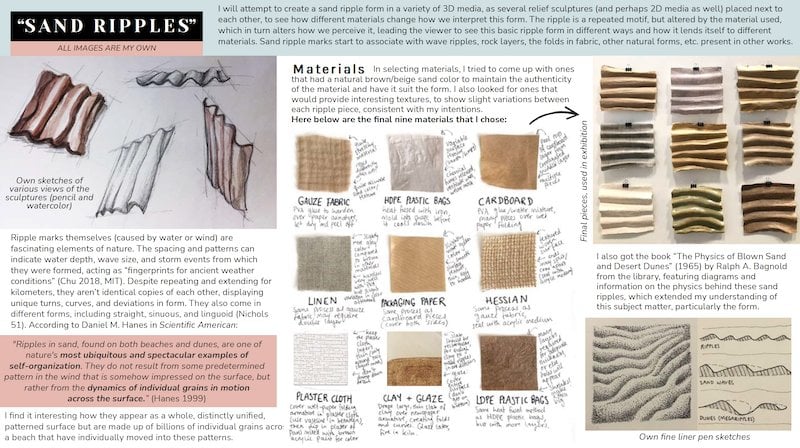
Google Slides is much like PowerPoint, except that students tin share links to their presentation or embed these within a blog mail service, making them more than transportable. Students can create presentations using a template created by the instructor, if required. Teachers frequently find that Google Slides is piece of cake for students to use, with a low learning-curve, although there are complaints about the fashion Google Slides compresses images, which can leave images blurry.
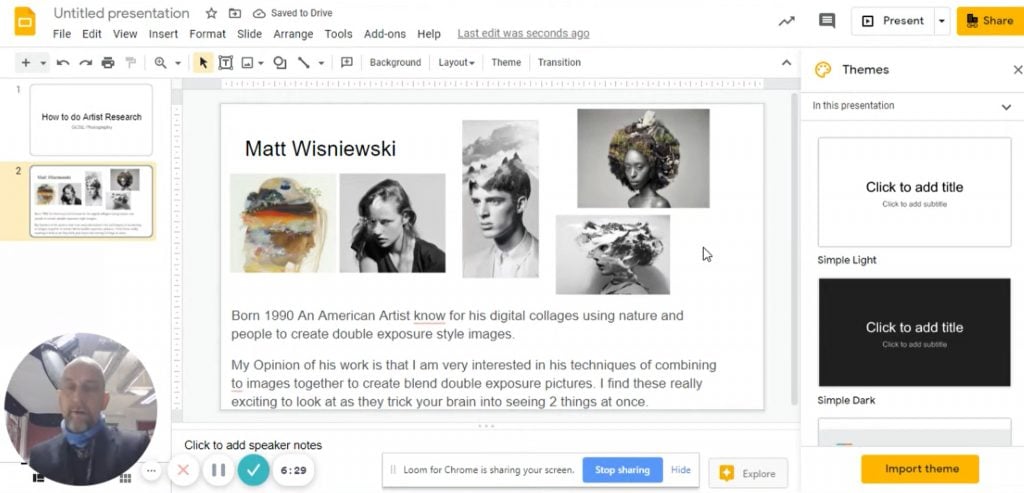
I issue with using slide-sharing tools is that submitting an unabridged twelvemonth's work in a single slideshow makes for a very long, heavy document. Some schools thus inquire student to submit a separate slideshow for each unit of measurement of work. Although slideshow tools can be used to create circuitous, high-quality presentations, different an ePortfolio website, they cannot be easily used to grow exposure online and are hence not as useful for career purposes.
Professional portfolio platforms such as Adobe Creative Deject Express or Behance
Another pick is to employ one of the free platforms used by artists and designers, such as Behance or Adobe Artistic Cloud Express (formerly known every bit Adobe Spark). These permit you to combine images and text upon website pages (enabling yous to gyre downward to see all content, rather than clicking through page afterward page). These are published online, easily shareable with others, and can be retained past the students after they go out schoolhouse.
Platforms such equally Adobe Creative Cloud Limited and Behance are typically aesthetically pleasing and piece of cake to use, so students tin go up and running with ease. Students frequently detect information technology motivating to have their piece of work published alongside that of practicing artists and designers (and feel every bit if they are creating a 'real' portfolio) which tin encourage high-quality portfolio creation.
Hither is an excellent Adobe Spark tutorial by Design and Photography instructor Stacey Churchill, describing how she uses ePortfolios within the classroom):
Note: Do not make the error of confusing Adobe Spark with Adobe Portfolio. A number of teachers take had students use Adobe Portfolio, only to discover at the cease of the project that it won't let students publish their portfolio without payment.
There are ii bug with these complimentary portfolio platforms. Firstly, they typically have very express customization options. Many senior high school students discover these platforms not flexible enough for their needs. Adobe Spark too doesn't allow comments and students cannot 'like' images, which some teachers observe reduces engagement within the classroom. Almost chiefly, withal, ePortfolios created using these platforms cannot be easily optimized for search engines, so it is difficult for others to find the portfolio when searching in Google. This means these platforms have limited usefulness if students promise to use the ePortfolio to grow a client base and promote themselves in the future.
A free web design platform such every bit Wix, Weebly, Google Sites or Blogger
Creating a stand up-lone website is the best option for senior loftier school students who wish to create an ePortfolio. Many students use a free web design platforms, such every bit Google Sites, Blogger, Weebly, or Wix. These platforms have drag-and-drop editors, and so students tin can create a website without any HTML or coding required.
Wix or Weebly are the almost versatile of these options, and have a professional, aesthetically pleasing appearance, resulting in a site that tin can exist kept following graduation, useful for scholarships and higher applications. Both Wix and Weebly take gratis and premium options.
Here is an excellent Weebly ePortfolio example by a senior high school student:
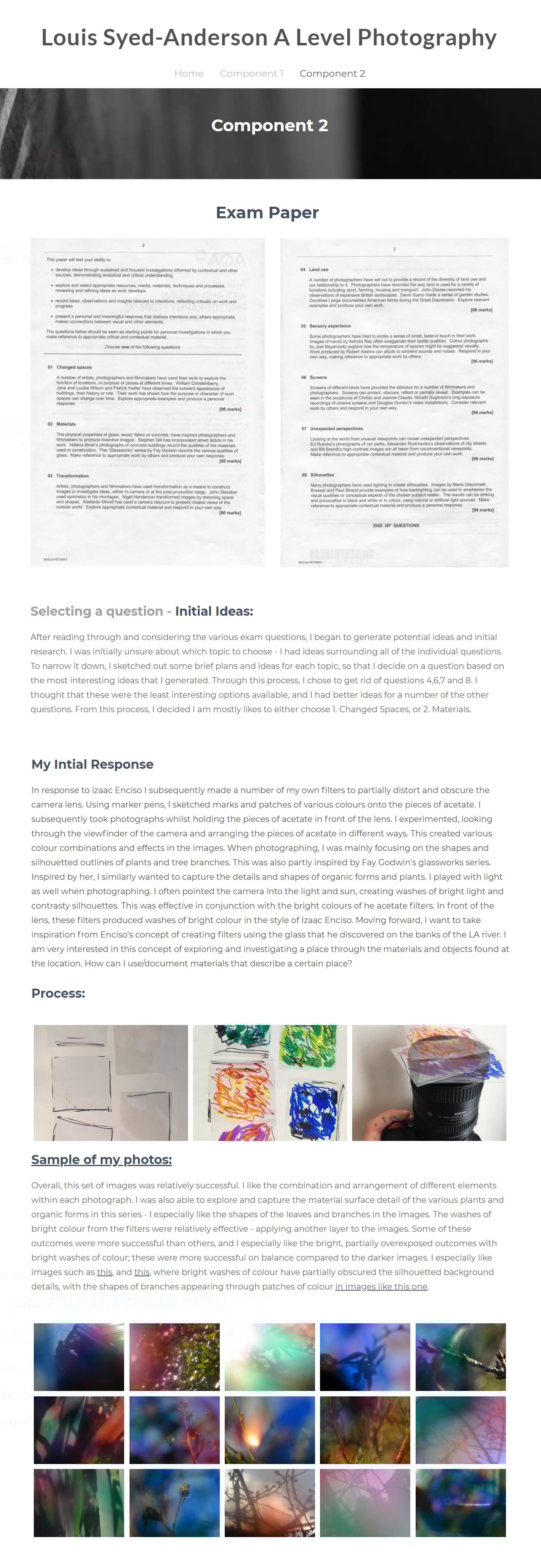
Some other option is Google Sites (this is the best Google service for creating an ePortfolio).
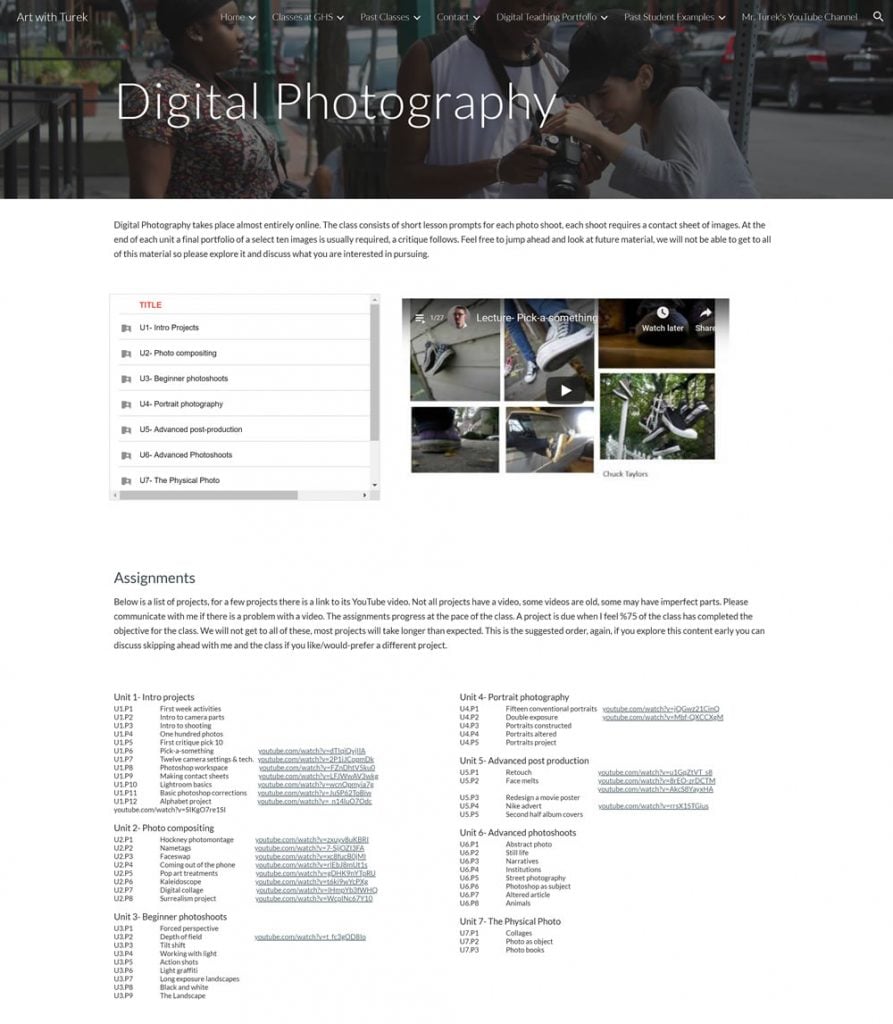
Wondering how to create an ePortfolio using google sites? Here is a great tutorial by Eric Neely, English instructor at The Academies of Bryan Station Loftier Schoolhouse, Kentucky, United States:
Google sites is very easy to use, notwithstanding some find information technology challenging to share student portfolio Google Sites with others (one instructor described "constantly dealing with blocking issues when they wanted to send to family members or outside agencies"). If a site is created using a student'southward schoolhouse login, a re-create of the site can exist shared with their personal Gmail business relationship when the educatee leaves, so they can retain it once they leave school, however this requires a few steps and may get a hassle when portfolios are created past multiple students. Other schools cannot use Google Sites at all (those designated as 'Microsoft schools' for example), because their students don't apply Gmail accounts. Some teachers have also commented that students cannot upload images directly from their phone to Google Sites – piece of work must exist saved in Google Drive and then uploaded them to Google Sites, meaning an extra step in the procedure.
Another Google platform that can be used to create a website is Blogger. This is an older platform, nevertheless it is still used by some students and teachers.
A problem encountered by many teachers wanting to create an ePortfolio for students is that a growing number of free platforms are blocked by schools. Sometimes, students or teachers spend considerable try building up a website or ePortfolio, or are halfway through a project, when the platform is suddenly blocked past their school, as high school photography teacher Wendy Dark-brown McElfish discovered start-hand:

Costless ePortfolio platforms are frequently blocked by schools because these sites attract spammers, who wait for cheap and easy ways to set up dodgy websites. To protect students from exposure to these spammy sites, the whole platform itself is often blocked and inaccessible by students.
To complicate things farther, many regions are bringing in laws and regulations relating to online education, which means that certain platforms are no longer able to be used with students. For instance, teachers in New York State were recently told they were unable to use Weebly anymore, as this is not compliant with the new 2022 NYS information drove privacy law. Other teachers are no longer able to use Wix with their students, due to new age restrictions brought in, with some teachers only permit those older than 18 to publish a site.
Another downside of building an ePortfolio with these tools, is that free platforms are decumbent to shut down unexpectedly. For example, Weebly recently announced that their teaching programme (which enabled teachers to manage and view student websites) will soon be discontinued, with all pupil sites and accounts disabled. Students will not be able to consign their websites, requiring students to manually cut and paste all material if they wish to go on their content.
[Weebly] volition no longer support student accounts subsequently August 1st, 2022. Students will non be able to log in, and their websites will be unpublished. We'll delete any student data in your business relationship…
Every bit another example, Wikispaces, which was one of the largest educational wiki sites used by teachers, suddenly disabled all complimentary and classroom wikis in 2018:
As stated in our communication in January 2022 and subsequent site banners; as of July 31st, 2022 all Gratis and Classroom Wikis were disabled and are no longer accessible.
Free website platforms are particularly vulnerable to collapse, because they do non direct generate revenue for the company. When times are tough, complimentary services are often the first to be cut. Such abrupt changes can have rather dramatic effects upon teaching programs, when hundreds of students might exist midway through projects using a item platform for their course.
Another downside of using one of these platforms is that Google does non like to show gratis websites in search engines (ePortfolios made using these tools are hence not very useful for driving traffic or growing clients – see more about this in our guide to creating an artist website) and optimizing content for search engines is difficult. This makes ePortfolios congenital with Wix, Weebly, and Google Sites far less useful for students who are slap-up to embark upon a creative career, considering it is much harder to drive traffic to these websites.
WordPress (highly recommended)
WordPress is one of the about popular website building tools, and powers nigh 38% of all websites on the net (the Educatee Art Guide was created using WordPress). It tin be used to create whatsoever type of website, with written text, illustrated articles, scrolling images, image galleries, embedded video clips, and and so on. WordPress is more complicated than Wix and Weebly, merely is well within the capabilities of many senior loftier schoolhouse students. By comparison, it is easier to utilise than other digital tools students often utilize, such as Adobe Photoshop.
Many teachers give students a choice between Wix, Weebly, Google Sites, and WordPress. Ane high schoolhouse teacher comments, "Wix seems to exist the crowd favorite, with some of my advanced students using WordPress." Another writes, "Been using Wix for several years. WordPress for the real serious kids."
Of import advantages of WordPress include:
- A WordPress website tin can be optimized for online search engines, making it easier for others to detect your artwork when they search in Google. (This is why WordPress is the all-time option for practising artists).
- Students can have their own website name (this is called a 'domain proper name'), such equally yourname.com. This creates a much more professional impression than yourname.freeservice.com.
- If students determine to sell artwork in the hereafter, they can hands add buy now buttons or shopping carts and sell direct from their WordPress site (this is not possible from the free platforms described higher up).
- An nigh infinite range of features can be added to a WordPress website – contact forms, email sign-up boxes, social media share buttons and then on. All of these are invaluable and are difficult or impossible to implement on most free platforms, enabling students to plough their ePortfolio is a professional website.
In fact, WordPress is considered and so useful for students that a growing number of loftier schools at present offer WordPress specific courses. High school teacher Zac Gordon, for example, describes teaching students to build websites for clients in the community, and began an internship program, where students started their ain companies working on WordPress sites for clients.
There are 2 versions of WordPress – the basic, gratuitous version, which is establish at WordPress.com (this has many of the same limitations as the other costless platforms described to a higher place), and self-hosted WordPress, which is installed at a 'website host'. A website host is a company that offers space for a website to be stored online then your site is live on the internet. Beginner hosting costs approximately $5 a calendar month (run across recommendations for hosting providers at the end of this article – the same hosting providers we recommend for artists). This price is inside the reach of some high school students – especially when savings in printing are considered. (Some teachers add website hosting to the course fees at the offset of the year, in replace of a reduced print budget.)
The Educatee Art Guide will shortly be publishing a free WordPress course for high schoolhouse students, containing all resource and lesson plans needed to teach WordPress within the classroom. This will be an online form that students and teachers tin can follow along at their own pace. It volition teach students how to build a website with WordPress, and volition include lesson plans covering the many ways in which web design can be utilized within the curriculum – such as logo blueprint, website layout design, and digital branding etc. We hope to publish this course in 2022. In the meantime, students may wish to scout the video tutorial we accept created for artists explaining how to gear up up a WordPress website.
Note: We are keen to feature more student websites, peculiarly WordPress ePortfolio examples, within this article. Do you have examples or experience using WordPress within the classroom that you lot would similar to share? Have your students designed websites equally part of their loftier school curriculum? Please brand contact via our contact grade! We would beloved to hear from y'all.
If y'all have establish this commodity helpful, please share using the social media buttons at the bottom of this page. Give thanks you!
BIBLIOGRAPHY
[one] E-Portfolio, Eye for Educational activity & Learning, Berkeley, Academy of California
[2] Dawn Bennett, Diana Blom, Peter Dunbar-Hall, Matthew Robert Hitchcock, Jennifer Rowley, ePortfolios for Artistic Arts, Music and Arts Students in Australian Universities (2015)
[iii] Candyce Reynolds, Associate Professor, quoted within The Benefits of Due east-portfolios for Students and Kinesthesia in Their Own Words, Peer Review, Vol. 11, No. 1 (2009)
[iv] Dawn Theresa Nicholson, Enhancing educatee engagement through online portfolio assessment, Practitioner Research in Higher Education, Vol. 11, No. one (2018)
[5] Jesse Strycker, K-12 Art Teacher Applied science Use and Training, ScienceDirect (2020)
[6] Megan Johnson and Maia Skarphol, The Effects of Digital Portfolios and Flipgrid on Pupil Engagement and Advice in a Connected Learning Secondary Visual Arts Classroom (2018)
[7] Planning & Developing Your Public Portfolio, Louisiana Country University
[viii] Hart Research Associates, It Takes More than a Major: Employer Priorities for College Learning and Student Success (2013)
[ix] Julie Beatrice Kristin, I'll Never Have to Do This After High School: Exploring Students' Perceptions of College and Career Readiness and the Effects of Eportfolios With Reflection on Transferable Skills (2020)
[10] David Sweet, Student Portfolios: Classroom Uses, Education Research Consumer Guide (1993)
[11] Darren Jamieson, What happens online stays online (2016)
[12] Adnan Baki, Osman Birgin, The Use of Portfolio to Assess Student'southward Performance (2007)
[13] Magda Barnard and Sonja Strydom, A tale of 2 faculties: Exploring student experiences of east-portfolio implementation as a vehicle of reflective learning at Stellenbosch University, The Independent Journal of Education and Learning, Vol. 12, No. 2 (2017)
[14] Greg Port, Why ePortfolios, All Saints' College (2020)
[15] Digital Portfolios: Guidelines for Beginners, Ian Munro, Ministry of Education, New Zealand (2011)

Amiria has been an Art & Design teacher and a Curriculum Co-ordinator for vii years, responsible for the grade design and assessment of student work in two high-achieving Auckland schools. She has a Bachelor of Architectural Studies, Available of Architecture (First Class Honours) and a Graduate Diploma of Teaching. Amiria is a CIE Accredited Art & Design Coursework Assessor.
Source: https://www.studentartguide.com/articles/how-to-make-an-eportfolio-for-students
0 Response to "How to make an ePortfolio: a guide for students & teachers"
Post a Comment